Paçoca: Difference between revisions
CSV import Tags: mobile edit mobile web edit |
CSV import |
||
| Line 27: | Line 27: | ||
{{Brazil-cuisine-stub}} | {{Brazil-cuisine-stub}} | ||
{{food-stub}} | {{food-stub}} | ||
<gallery> | |||
File:Paçoca.jpg|Paçoca | |||
File:Paçoquinha_de_amendoim_tipo_rolha.jpg|Paçoquinha de amendoim tipo rolha | |||
File:Paçoca_S_(119399301).jpeg|Paçoca | |||
</gallery> | |||
Latest revision as of 02:08, 18 February 2025
Paçoca is a traditional Brazilian candy made from peanuts, sugar, and salt. Some variations may include cassava flour. It is particularly popular during the Festa Junina, a Brazilian festival that takes place in June, but it is consumed year-round.
History[edit]
The word "paçoca" comes from the Tupi word "posok" or "paçoc", which means "to crumble" or "to shred". It was originally made by the indigenous peoples of Brazil, who would grind peanuts with maize.
Preparation[edit]
To prepare paçoca, peanuts are first roasted and then ground into a fine powder. Sugar and salt are added to the peanut powder and mixed thoroughly. The mixture is then pressed into a mold to form small cylinders, which are then allowed to dry.
Variations[edit]
There are several variations of paçoca, including paçoca de pilão and paçoca de colher. Paçoca de pilão is made by pounding the ingredients together in a large mortar and pestle, while paçoca de colher is a softer version that can be eaten with a spoon.
Cultural significance[edit]
Paçoca is often associated with the Festa Junina, a festival that celebrates the nativity of John the Baptist. During this festival, paçoca is often served alongside other traditional foods such as pamonha and canjica.
See also[edit]

This article is a Brazilian cuisine–related stub. You can help WikiMD by expanding it!

-
 Paçoca
 -
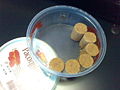 Paçoquinha de amendoim tipo rolha
 -
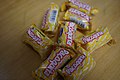 Paçoca


.jpeg)
