Amanita phalloides: Difference between revisions
CSV import Tags: mobile edit mobile web edit |
CSV import |
||
| Line 21: | Line 21: | ||
[[Category:Amanita]] | [[Category:Amanita]] | ||
{{Fungus-stub}} | {{Fungus-stub}} | ||
<gallery> | |||
File:Alpha-amanitin_structure.png|Structure of Alpha-amanitin | |||
File:Beta-amanitin_structure.png|Structure of Beta-amanitin | |||
File:Death_Cap_Mushroom.jpg|Amanita phalloides (Death Cap Mushroom) | |||
</gallery> | |||
Latest revision as of 02:02, 18 February 2025
Amanita phalloides, commonly known as the death cap, is a deadly poisonous basidiomycete fungus, one of many in the genus Amanita. Native to Europe, Amanita phalloides forms mycorrhiza with various broadleaved trees. In some cases, the death cap has been introduced to new regions with the cultivation of non-native species of oak, chestnut, and pine. The large fruiting bodies (mushrooms) appear in summer and autumn; the sporocarps are highly toxic if ingested.
Description[edit]
Amanita phalloides is a large mushroom and its cap varies from 5 to 15 cm across. It is usually pale olive to an olive-brown color, and is covered with a sticky, slimy layer. The gills are white, as is the spore print. The stem, also white, bears a skirt-like ring and the base is surrounded by a white sac-like volva.
Toxicity[edit]
Amanita phalloides is one of the most poisonous of all known toadstools. It is estimated that as little as half a mushroom contains enough toxin to kill an adult human. It has been involved in the majority of human deaths from mushroom poisoning, possibly including the deaths of Roman Emperor Claudius and Holy Roman Emperor Charles VI.
Distribution and habitat[edit]
Amanita phalloides is native to Europe, but has been accidentally introduced to other countries, in some cases becoming an invasive species. It is found in woodland areas, particularly in association with oak, chestnut, and pine.
See also[edit]

-
 Structure of Alpha-amanitin
 -
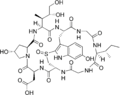 Structure of Beta-amanitin
 -
 Amanita phalloides (Death Cap Mushroom)


