Sphenoid wing meningioma: Difference between revisions
CSV import |
CSV import |
||
| Line 31: | Line 31: | ||
[[Category:Brain tumors]] | [[Category:Brain tumors]] | ||
{{medicine-stub}} | {{medicine-stub}} | ||
<gallery> | |||
File:Keilbeinmeningeom_MRT_T1KMax.jpg|Sphenoid wing meningioma MRI T1 with contrast | |||
File:Keilbeinmeningeom_CT_ax.png|Sphenoid wing meningioma CT axial view | |||
</gallery> | |||
Latest revision as of 01:59, 18 February 2025
Sphenoid Wing Meningioma is a type of brain tumor that originates from the meninges, the protective membranes that cover the brain and spinal cord. Specifically, this tumor arises from the sphenoid wing, which is part of the sphenoid bone located at the base of the skull. Meningiomas are generally slow-growing tumors and are most often benign, though their location can lead to significant neurological symptoms and complications.
Symptoms[edit]
The symptoms of a Sphenoid Wing Meningioma can vary widely depending on the tumor's size and exact location. Common symptoms may include:
- Headaches
- Visual disturbances such as blurred vision or double vision
- Loss of sensation or weakness in the face
- Seizures
- Changes in personality or cognitive function
Diagnosis[edit]
Diagnosis of a Sphenoid Wing Meningioma typically involves a combination of medical history, physical examination, and imaging studies. The most commonly used imaging tests are:
- Magnetic Resonance Imaging (MRI): Provides detailed images of the brain and is particularly useful in identifying meningiomas.
- Computed Tomography (CT) Scan: Can also be used, especially if MRI is contraindicated.
In some cases, a biopsy may be performed to definitively diagnose the tumor type, though this is less common for meningiomas located in challenging areas like the sphenoid wing.
Treatment[edit]
Treatment options for Sphenoid Wing Meningioma depend on the tumor's size, growth rate, and the presence of symptoms. Options may include:
- Observation: Small, asymptomatic tumors may simply be monitored over time with regular imaging tests.
- Surgery: The primary treatment for symptomatic or growing meningiomas. The goal is to remove as much of the tumor as possible while minimizing damage to surrounding brain tissue.
- Radiation therapy: May be used after surgery to destroy any remaining tumor cells or as a primary treatment if surgery is not feasible.
Prognosis[edit]
The prognosis for individuals with Sphenoid Wing Meningioma is generally good, especially for tumors that can be completely removed surgically. However, the tumor's location near critical brain structures can make treatment challenging and may increase the risk of complications.
Epidemiology[edit]
Meningiomas are the most common type of primary brain tumor, accounting for about 30% of all cases. However, Sphenoid Wing Meningiomas are less common. The incidence of meningiomas is higher in women than in men and typically occurs in middle-aged or older adults.

-
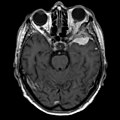 Sphenoid wing meningioma MRI T1 with contrast
 -
 Sphenoid wing meningioma CT axial view


