Coleslaw: Difference between revisions
CSV import |
CSV import |
||
| Line 33: | Line 33: | ||
[[Category:Vegetable dishes]] | [[Category:Vegetable dishes]] | ||
{{food-stub}} | {{food-stub}} | ||
<gallery> | |||
File:2015-12-20_Spitzkohlsalat_mit_Möhren_anagoria.JPG|Coleslaw | |||
File:Purple_cabbage_coleslaw.jpg|Coleslaw | |||
</gallery> | |||
Latest revision as of 01:53, 18 February 2025
Coleslaw


Coleslaw, also known as slaw, is a popular salad consisting primarily of finely shredded raw cabbage with a salad dressing commonly made from either vinaigrette or mayonnaise. Variations of coleslaw may include other shredded vegetables like carrots, as well as mix-ins such as apples, onions, and cheese. Coleslaw is served as a side dish with a variety of foods and is a staple at barbecues, picnics, and fast food restaurants.
History[edit]
The term "coleslaw" originated from the Dutch word koolsla, where kool means cabbage and sla is salad, reflecting the dish's likely Dutch origins. The recipe was brought to America by Dutch immigrants who settled in the New York area, then known as New Amsterdam. Over time, coleslaw evolved, especially in the United States, where mayonnaise became a common ingredient in the 18th century.
Ingredients and Preparation[edit]
The basic ingredient in coleslaw is raw cabbage, which is finely shredded. The dressing for coleslaw is typically made from mayonnaise, vinegar, sugar, and spices, although there are many regional and personal variations. Some prefer a vinaigrette base, incorporating vinegar and oil, for a lighter version. Additional ingredients can include carrots, onions, apples, and sometimes nuts or raisins, which add texture and flavor.
Variations[edit]
Coleslaw can vary widely in flavor and ingredients. Some common variations include:
- Vinegar-based coleslaw, which omits the mayonnaise for a tangier taste.
- Creamy coleslaw, which includes a generous amount of mayonnaise for a richer texture.
- Regional variations, such as those incorporating blue cheese in the dressing or adding mustard for additional tang.
Serving[edit]
Coleslaw is often served as a side dish alongside dishes such as fried chicken, barbecue ribs, and sandwiches. It is also a common topping for hot dogs and hamburgers, especially in certain regions of the United States.
Nutritional Information[edit]
Coleslaw can be a healthy addition to a meal, as cabbage is rich in vitamins C and K. However, the nutritional value can vary significantly depending on the type of dressing used. Mayonnaise-based dressings, for example, are higher in calories and fat.
Cultural Significance[edit]
Coleslaw has become a part of various culinary traditions around the world, adapting to local tastes and available ingredients. It is particularly associated with American cuisine, where it is a staple at outdoor gatherings like barbecues and picnics.

-
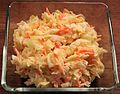 Coleslaw
 -
 Coleslaw


