Macadamia integrifolia: Difference between revisions
CSV import |
CSV import |
||
| Line 26: | Line 26: | ||
{{Australia-stub}} | {{Australia-stub}} | ||
{{tree-stub}} | {{tree-stub}} | ||
<gallery> | |||
File:Macadamia_integrifolia_inflorescences_74_Sunbury_St_Geebung_L1060475.jpg|Macadamia integrifolia inflorescences | |||
File:Starr-081111-0455-Macadamia_integrifolia-different_stages-Makawao-Maui_(24299912723).jpg|Macadamia integrifolia different stages | |||
</gallery> | |||
Latest revision as of 01:53, 18 February 2025
Macadamia integrifolia is a species of tree in the family Proteaceae, native to southeastern Queensland and northeastern New South Wales in Australia. It is well known for its edible fruit, the macadamia nut.
Description[edit]
Macadamia integrifolia is an evergreen tree that grows up to 15 meters tall. The leaves are arranged in whorls of three to six, lanceolate to obovate or elliptical in shape, 7–25 cm long and 2–13 cm broad, with an entire or spiny-serrated margin. The flowers are produced in a long, slender, simple raceme 5–30 cm long, the individual flowers 10–15 mm long, white to pink or purple, with four tepals.
Distribution and habitat[edit]
Macadamia integrifolia is native to rainforests in southeastern Queensland and northeastern New South Wales, growing in fertile, well-drained soils in a protected, sunny position. It is also cultivated in Hawaii and California for its nuts.
Cultivation and uses[edit]
The tree is commercially important for its fruit, the macadamia nut (or simply macadamia). Other parts of the tree are also used in the production of non-edible products such as cosmetics and skincare products.
See also[edit]
References[edit]
<references />
External links[edit]


-
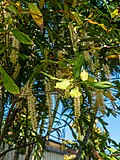 Macadamia integrifolia inflorescences
 -
 Macadamia integrifolia different stages

.jpg)
