Promontory of tympanic cavity: Difference between revisions
CSV import |
CSV import |
||
| Line 42: | Line 42: | ||
[[Category:Hearing]] | [[Category:Hearing]] | ||
[[Category:Medical Procedures]] | [[Category:Medical Procedures]] | ||
<gallery> | |||
File:Gray911.png|Promontory of tympanic cavity | |||
File:Gray913.png|Promontory of tympanic cavity | |||
File:Gray914.png|Promontory of tympanic cavity | |||
</gallery> | |||
Latest revision as of 01:51, 18 February 2025
Promontory of Tympanic Cavity[edit]
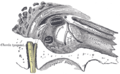
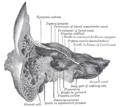
The promontory of the tympanic cavity is a prominent anatomical feature located within the middle ear. It is a bony projection that separates the middle ear from the inner ear and plays a crucial role in the transmission of sound waves.
Anatomy[edit]
The promontory is formed by the basal turn of the cochlea, which is the spiral-shaped structure responsible for hearing. It is situated on the medial wall of the middle ear, adjacent to the oval window. The oval window is a membrane-covered opening that connects the middle ear to the inner ear.
The promontory is covered by a thin layer of mucous membrane, which is continuous with the lining of the middle ear. This mucous membrane contains numerous blood vessels and nerve endings, making the promontory highly sensitive.
Function[edit]
The main function of the promontory is to transmit sound vibrations from the middle ear to the inner ear. When sound waves enter the ear canal, they cause the eardrum to vibrate. These vibrations are then transmitted through the ossicles (the small bones of the middle ear) to the oval window.
As the oval window moves in response to the sound vibrations, it creates pressure waves within the fluid-filled cochlea. These pressure waves stimulate the hair cells within the cochlea, which convert the mechanical energy of the sound waves into electrical signals that can be interpreted by the brain as sound.
The promontory plays a crucial role in this process by acting as a bridge between the middle ear and the inner ear. Its location adjacent to the oval window allows for efficient transmission of sound vibrations, ensuring optimal hearing function.
Clinical Significance[edit]
The promontory of the tympanic cavity can be of clinical significance in certain medical conditions. For example, in cases of otosclerosis, a condition characterized by abnormal bone growth in the middle ear, the promontory may become fixed and immobile. This can lead to conductive hearing loss, as the transmission of sound vibrations is impaired.
Furthermore, the promontory can serve as a landmark during surgical procedures involving the middle ear. Surgeons may use the promontory as a reference point when performing procedures such as cochlear implantation or stapedectomy.
See Also[edit]
- Middle Ear
- Inner Ear
- Oval Window
- Cochlea
- Otosclerosis
- Conductive Hearing Loss
- Cochlear Implantation
- Stapedectomy
References[edit]
<references />
-
 Promontory of tympanic cavity
 -
 Promontory of tympanic cavity
 -
 Promontory of tympanic cavity


