Economic surplus: Difference between revisions
CSV import |
CSV import |
||
| Line 41: | Line 41: | ||
[[Category:Microeconomics]] | [[Category:Microeconomics]] | ||
[[Category:Welfare economics]] | [[Category:Welfare economics]] | ||
<gallery> | |||
File:Economic-surpluses.svg|Economic Surpluses Diagram | |||
File:Producer_Surplus_graph_made_by_Weiyi.png|Producer Surplus Graph | |||
</gallery> | |||
Latest revision as of 01:45, 18 February 2025
Economic Surplus[edit]
Economic surplus is a fundamental concept in economics that refers to the benefits that individuals or society receive from engaging in economic activities. It is the sum of consumer surplus and producer surplus, representing the total net benefit to society from the production and consumption of goods and services.
Consumer Surplus[edit]
Consumer surplus is the difference between what consumers are willing to pay for a good or service and what they actually pay. It measures the benefit consumers receive when they purchase a product for less than the maximum price they are willing to pay.
Calculation[edit]
Consumer surplus can be calculated using the demand curve. It is the area below the demand curve and above the price level, up to the quantity purchased. Mathematically, it can be expressed as:
where is the demand price, is the market price, and is the quantity.
Producer Surplus[edit]
Producer surplus is the difference between what producers are willing to accept for a good or service and what they actually receive. It represents the benefit producers receive when they sell a product for more than the minimum price they are willing to accept.
Calculation[edit]
Producer surplus can be calculated using the supply curve. It is the area above the supply curve and below the price level, up to the quantity sold. Mathematically, it can be expressed as:
where is the supply price, is the market price, and is the quantity.
Total Economic Surplus[edit]
Total economic surplus is the sum of consumer surplus and producer surplus. It represents the total net benefit to society from the production and consumption of a good or service. Maximizing economic surplus is often a goal of economic policy, as it indicates an efficient allocation of resources.
Importance in Economics[edit]
Economic surplus is a key indicator of economic efficiency. It is used to assess the welfare effects of different market structures, government policies, and externalities. For example, in a perfectly competitive market, economic surplus is maximized, indicating an efficient allocation of resources. In contrast, monopolies or other market failures can lead to a reduction in economic surplus, indicating inefficiency.
Related Concepts[edit]
- Deadweight loss: The loss of economic surplus due to market inefficiencies, such as taxes or monopolies.
- Pareto efficiency: A state where no individual can be made better off without making someone else worse off, often associated with maximum economic surplus.
- Welfare economics: The study of how economic activity affects social welfare, often using economic surplus as a measure.
References[edit]
- Varian, H. R. (2010). Intermediate Microeconomics: A Modern Approach. W.W. Norton & Company.
- Mankiw, N. G. (2014). Principles of Economics. Cengage Learning.
-
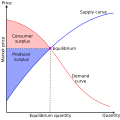 Economic Surpluses Diagram
 -
 Producer Surplus Graph


