Ureterocele: Difference between revisions
CSV import |
CSV import |
||
| Line 37: | Line 37: | ||
[[Category:Congenital disorders of urinary system]] | [[Category:Congenital disorders of urinary system]] | ||
[[Category:Urology]] | [[Category:Urology]] | ||
== Ureterocele == | |||
<gallery> | |||
File:Ultrasound_Scan_ND_459.jpg|Ultrasound scan showing ureterocele | |||
File:Ureterocele_bei_Doppelniere_links_-_CT_ax_und_cor.jpg|CT scan of ureterocele with duplex kidney on the left | |||
</gallery> | |||
Revision as of 01:45, 18 February 2025
A medical condition involving the ureter
Ureterocele
A ureterocele is a congenital abnormality found in the urinary tract. It occurs when the distal ureter balloons at its opening into the bladder, forming a sac-like pouch. This condition can lead to obstruction of urine flow and can affect kidney function.
Presentation
Ureteroceles are often diagnosed in childhood, but they can also be discovered in adults. Symptoms may include urinary tract infections, hematuria (blood in the urine), and abdominal pain. In some cases, ureteroceles are asymptomatic and are found incidentally during imaging studies for other conditions.
Diagnosis
The diagnosis of a ureterocele is typically made using imaging techniques. An ultrasound scan is often the first step, as it can reveal the presence of a cystic structure within the bladder. Further imaging, such as a CT scan or an intravenous pyelogram, may be used to assess the anatomy of the urinary tract and the function of the kidneys.


Classification
Ureteroceles can be classified based on their location and the presence of a duplicated collecting system. The two main types are:
- Intravesical ureterocele: Located entirely within the bladder.
- Ectopic ureterocele: Extends beyond the bladder neck, often associated with a duplicated collecting system.
Treatment
The treatment of a ureterocele depends on the severity of the condition and the presence of symptoms. Options include:
- Endoscopic incision: A minimally invasive procedure to puncture the ureterocele and allow urine to flow freely.
- Surgical reconstruction: In cases of significant obstruction or associated anomalies, surgical intervention may be necessary to reconstruct the urinary tract.
- Observation: In asymptomatic cases, especially in infants, careful monitoring may be sufficient.
Prognosis
With appropriate treatment, the prognosis for individuals with a ureterocele is generally good. Early diagnosis and management are crucial to prevent complications such as recurrent infections and kidney damage.
Related pages
Ureterocele
-
 Ultrasound scan showing ureterocele
 -
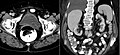 CT scan of ureterocele with duplex kidney on the left
