Umeboshi: Difference between revisions
CSV import |
CSV import |
||
| Line 41: | Line 41: | ||
[[Category:Pickles]] | [[Category:Pickles]] | ||
[[Category:Fermented foods]] | [[Category:Fermented foods]] | ||
<gallery> | |||
File:Umeboshi2.JPG|Umeboshi | |||
File:Umeboshi.jpg|Umeboshi | |||
File:Umebosi_Doyobosi.jpg|Umeboshi | |||
</gallery> | |||
Latest revision as of 01:43, 18 February 2025
Umeboshi[edit]


Umeboshi (__) are pickled ume fruits common in Japan. They are known for their distinctive sour and salty taste, and are often served as a side dish or used as a filling for onigiri (rice balls). Umeboshi are traditionally made by drying ume fruits in the sun and then pickling them in a brine solution.
Preparation[edit]
The process of making umeboshi begins with the harvesting of ume fruits, which are similar to apricots and plums. The fruits are picked when they are still green and firm. After harvesting, the ume are soaked in water to remove any bitterness. They are then layered with salt in a container and left to ferment for several weeks.
During the fermentation process, the ume are pressed to remove excess liquid, which is known as umezu. The ume are then dried in the sun for several days, a process known as "doyoboshi." After drying, the ume are placed back into the umezu or a new brine solution to continue fermenting.
Variations[edit]
There are several variations of umeboshi, depending on the region and the specific preparation methods. Some umeboshi are flavored with shiso leaves, which give them a reddish color and a slightly different taste. Others may be sweetened or have additional spices added.
Health Benefits[edit]
Umeboshi are believed to have various health benefits. They are high in citric acid, which is thought to aid digestion and improve energy levels. Umeboshi are also said to have antibacterial properties and are sometimes used as a natural remedy for nausea and fatigue.
Cultural Significance[edit]
In Japanese culture, umeboshi are often associated with longevity and health. They are a traditional food that has been consumed for centuries and are commonly included in bento boxes. Umeboshi are also used in Japanese cuisine to add flavor to dishes and are sometimes served with rice or tea.
Related Pages[edit]
References[edit]
- "Umeboshi." Japan: An Illustrated Encyclopedia. Tokyo: Kodansha, 1993.
- Shurtleff, William, and Akiko Aoyagi. "The Book of Miso." New York: Ballantine Books, 1976.
- "Umeboshi: The Japanese Superfood." Japan Times, 2020.
-
 Umeboshi
 -
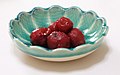 Umeboshi
 -
 Umeboshi

