Trichomegaly: Difference between revisions
CSV import |
CSV import |
||
| Line 31: | Line 31: | ||
[[Category:Eye diseases]] | [[Category:Eye diseases]] | ||
[[Category:Genetic disorders]] | [[Category:Genetic disorders]] | ||
<gallery> | |||
File:Closed_human_eye,_superior_view.jpg|Closed human eye, superior view | |||
File:Human_eye,_lateral_view.jpg|Human eye, lateral view | |||
File:Eyelash_trichomegaly.jpg|Eyelash trichomegaly | |||
</gallery> | |||
Revision as of 01:38, 18 February 2025
Trichomegaly


Trichomegaly is a condition characterized by the abnormal growth of eyelashes, resulting in excessive length, curling, pigmentation, or thickness. This condition can be congenital or acquired and may be associated with various systemic diseases or medications.
Causes
Trichomegaly can be caused by a variety of factors, including:
- Genetic conditions: Certain genetic disorders, such as Oliver-McFarlane syndrome and Cornelia de Lange syndrome, are known to cause trichomegaly.
- Medications: Drugs such as epidermal growth factor receptor inhibitors, used in cancer treatment, can lead to trichomegaly as a side effect.
- Systemic diseases: Conditions like HIV/AIDS and lupus erythematosus have been associated with trichomegaly.
Diagnosis
Diagnosis of trichomegaly is primarily clinical, based on the observation of unusually long or thick eyelashes. A thorough medical history and examination can help identify any underlying causes or associated conditions.
Treatment
Treatment of trichomegaly depends on the underlying cause. If the condition is drug-induced, discontinuation or substitution of the medication may be considered. In cases where trichomegaly causes discomfort or vision problems, trimming of the eyelashes may be recommended.
Related pages
References
<references group="" responsive="1"></references>
-
 Closed human eye, superior view
 -
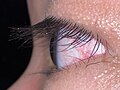 Human eye, lateral view
 -
 Eyelash trichomegaly

