Webbed toes: Difference between revisions
CSV import |
CSV import |
||
| Line 23: | Line 23: | ||
{{congenital disorder-stub}} | {{congenital disorder-stub}} | ||
{{genetics-stub}} | {{genetics-stub}} | ||
<gallery> | |||
File:Celldeath.jpg|Webbed_toes | |||
File:Webbed_toes_b4.jpg|Webbed_toes | |||
File:Webbed_toes_after.jpg|Webbed_toes | |||
</gallery> | |||
Revision as of 01:36, 18 February 2025
Webbed toes is a condition where two or more toes are fused together by skin or soft tissue. This condition, also known as Syndactyly, is a common congenital abnormality that occurs in humans and animals. It is often identified at birth and can affect one or both feet.
Causes
Webbed toes can be caused by a variety of factors. The most common cause is genetic, where the condition is passed down from parents to their children. It can also be caused by environmental factors during pregnancy, such as exposure to certain drugs or chemicals. In some cases, the cause of webbed toes is unknown.
Diagnosis
Diagnosis of webbed toes is usually made at birth by a physical examination. In some cases, the condition may be detected before birth during a routine ultrasound scan. Further tests may be required to determine if the webbing is part of a larger syndrome or condition.
Treatment
Treatment for webbed toes depends on the severity of the condition and the presence of any associated conditions. In mild cases, no treatment may be necessary. In more severe cases, surgery may be recommended to separate the toes. This is usually performed in early childhood.
Prognosis
The prognosis for individuals with webbed toes is generally good. Most people with this condition lead normal, healthy lives. However, some may experience difficulties with balance or walking, and may require physical therapy or other treatments.
See also

-
 Webbed_toes
 -
 Webbed_toes
 -
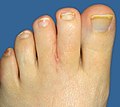 Webbed_toes


