Ganoderma brownii: Difference between revisions
CSV import |
CSV import |
||
| Line 24: | Line 24: | ||
{{Fungi-stub}} | {{Fungi-stub}} | ||
{{food-stub}} | {{food-stub}} | ||
== Ganoderma_brownii == | |||
<gallery> | |||
File:Artist's_Conk_imported_from_iNaturalist_photo_253998564_on_27_February_2024.jpg|Ganoderma brownii | |||
File:Ganoderma_brownii_spores_1000x.jpg|Ganoderma brownii spores at 1000x magnification | |||
</gallery> | |||
Latest revision as of 01:32, 18 February 2025
Ganoderma brownii is a species of polypore fungus in the family Ganodermataceae. It is a wood-decay fungus, with a preference for hardwoods. The species was first described scientifically by American mycologist William Alphonso Murrill in 1908. It is commonly known as the Brown's Ganoderma.
Taxonomy[edit]
The species was first described in the scientific literature by American mycologist William Alphonso Murrill in 1908. The specific epithet brownii honors the American botanist Robert Brown.
Description[edit]
The fruit body of Ganoderma brownii is a large, perennial polypore that grows on the trunks of living and dead trees. The cap is up to 30 cm (12 in) in diameter, with a shiny, varnished appearance. The color ranges from reddish-brown to black. The spores are brown, elliptical, and have a double wall.
Habitat and distribution[edit]
Ganoderma brownii is found in North America, particularly in the Pacific Northwest. It is a saprophytic fungus, meaning it feeds on dead or decaying organic material. It has a preference for hardwoods, especially oak.
Uses[edit]
While Ganoderma brownii is not typically used for culinary purposes due to its tough texture, it has been used in traditional medicine. Some studies suggest that it may have antioxidant and anti-inflammatory properties.
See also[edit]
References[edit]
<references />


Ganoderma_brownii[edit]
-
 Ganoderma brownii
 -
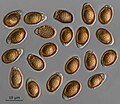 Ganoderma brownii spores at 1000x magnification


