Intestinal capillariasis: Difference between revisions
CSV import Tags: mobile edit mobile web edit |
CSV import Tags: mobile edit mobile web edit |
||
| Line 32: | Line 32: | ||
{{Parasitic-diseases-stub}} | {{Parasitic-diseases-stub}} | ||
{{Nematode-stub}} | {{Nematode-stub}} | ||
== Intestinal_capillariasis == | |||
<gallery> | |||
File:CapillariaPhilippEgg.jpg|Capillaria philippinensis egg | |||
File:Capillaria_infection_in_a_16_year_old_girl_(Philippines).jpg|Capillaria infection in a 16-year-old girl (Philippines) | |||
</gallery> | |||
Revision as of 01:32, 18 February 2025
Intestinal capillariasis is a rare parasitic disease caused by the nematode Capillaria philippinensis. The disease is primarily endemic in the Philippines, but cases have been reported in other parts of the world. The disease is characterized by severe diarrhea, malabsorption, and electrolyte imbalance, which can lead to life-threatening complications if not treated promptly.
Etiology
Intestinal capillariasis is caused by the ingestion of raw or undercooked fish infected with the larvae of Capillaria philippinensis. The parasite is a small, hair-like nematode that resides in the small intestine of humans. The adult worms produce eggs that are passed in the feces, which can contaminate water sources and infect fish.
Clinical Manifestations
The disease typically presents with chronic diarrhea, abdominal pain, and weight loss. Other symptoms may include anorexia, nausea, and vomiting. In severe cases, patients may develop malnutrition, dehydration, and electrolyte imbalances, which can lead to complications such as cardiac arrhythmia and shock.
Diagnosis
Diagnosis of intestinal capillariasis is made by identifying Capillaria philippinensis eggs or adult worms in stool samples. Other diagnostic methods may include endoscopy and biopsy of the small intestine.
Treatment
Treatment for intestinal capillariasis involves the use of anthelmintic drugs, such as mebendazole or albendazole. In severe cases, hospitalization may be required for rehydration and correction of electrolyte imbalances.
Prevention
Prevention of intestinal capillariasis primarily involves avoiding the consumption of raw or undercooked fish in endemic areas. Improved sanitation and proper cooking of fish can also help to prevent the spread of the disease.
See Also
This parasitic disease-related article is a stub. You can help WikiMD by expanding it.

Intestinal_capillariasis
-
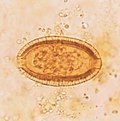 Capillaria philippinensis egg
 -
 Capillaria infection in a 16-year-old girl (Philippines)

.jpg)
