Tetralin: Difference between revisions
CSV import Tags: mobile edit mobile web edit |
CSV import |
||
| Line 23: | Line 23: | ||
{{Chem-stub}} | {{Chem-stub}} | ||
<gallery> | |||
File:Tetralin.svg|Tetralin | |||
File:Tetralin_synthesis_01.svg|Tetralin synthesis | |||
File:Darzens_Synthesis_of_Tetralin_Derivatives.svg|Darzens Synthesis of Tetralin Derivatives | |||
</gallery> | |||
Latest revision as of 01:32, 18 February 2025
Tetralin (1,2,3,4-tetrahydronaphthalene) is an organic compound that is a hydrogenated derivative of naphthalene. Consisting of a cyclohexane ring fused with a benzene ring, tetralin is a colorless liquid with a characteristic odor. It is used as a solvent, in the synthesis of pharmaceuticals, and as a component in some fuel mixtures. The chemical formula of tetralin is C10H12.
Properties[edit]
Tetralin has a boiling point of approximately 207°C and a melting point of -31.5°C. It is slightly soluble in water but highly soluble in organic solvents such as ethanol, diethyl ether, and benzene. Tetralin exhibits both the chemical properties of alkanes, due to its cyclohexane ring, and the aromatic properties of benzene, due to its benzene ring.
Production[edit]
Tetralin is produced by the hydrogenation of naphthalene at high temperatures and pressures in the presence of a catalyst. This process converts the two double bonds in naphthalene into single bonds, resulting in the formation of tetralin.
Uses[edit]
Tetralin is primarily used as an industrial solvent for fats, resins, oils, and waxes due to its ability to dissolve a wide range of organic materials. It is also used in the manufacture of dyes, pharmaceuticals, and synthetic resins. In addition, tetralin can be used as a component in jet fuel mixtures and as a paint thinner.
Health and Safety[edit]
Exposure to tetralin can occur through inhalation, ingestion, or skin contact. It is considered to be moderately toxic and can cause irritation to the skin, eyes, and respiratory tract. Prolonged or repeated exposure may lead to more severe health effects, including neurological symptoms such as headache, dizziness, and fatigue. Safety measures include using tetralin in well-ventilated areas, wearing protective clothing, and following proper storage and handling procedures.
Environmental Impact[edit]
Tetralin can have adverse effects on the environment if it is released in large quantities. It is capable of contaminating water sources and soil, posing risks to aquatic life and potentially entering the food chain. Measures should be taken to prevent spills and to manage waste properly.
Regulation[edit]
The use and handling of tetralin are regulated by various health and safety guidelines to minimize exposure and environmental impact. These regulations may vary by country and region, emphasizing the importance of compliance with local laws and standards.

-
 Tetralin
 -
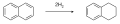 Tetralin synthesis
 -
 Darzens Synthesis of Tetralin Derivatives


