Assortative mating: Difference between revisions
CSV import |
CSV import |
||
| Line 32: | Line 32: | ||
[[Category:Sexual selection]] | [[Category:Sexual selection]] | ||
{{biology-stub}} | {{biology-stub}} | ||
<gallery> | |||
File:Scarlet_lily_beetle_lilioceris_lilii.jpg|Scarlet lily beetle | |||
File:Bufo_japonicus_formosus.jpg|Japanese toad | |||
</gallery> | |||
Latest revision as of 01:29, 18 February 2025
Assortative mating is a mating pattern and a form of sexual selection in which individuals with similar phenotypes mate with one another more frequently than would be expected under a random mating pattern. This phenomenon can be observed in many species, including humans, and has significant implications for the genetic structure of populations.
Overview[edit]
Assortative mating can be either positive or negative. Positive assortative mating, also known as homogamy, occurs when similar individuals mate with each other more frequently than would be expected by chance. This can lead to an increase in genetic relatedness within families. On the other hand, negative assortative mating, or heterogamy, occurs when dissimilar individuals mate more frequently. This can increase genetic diversity within families.
Mechanisms[edit]
The mechanisms behind assortative mating can be complex and multifaceted. They can include physical characteristics, such as size or color, behavioral traits, such as aggression or sociability, and even genetic markers. In many cases, these traits are correlated, leading to a phenomenon known as correlational selection.
Implications[edit]
Assortative mating has important implications for the genetic structure of populations. It can lead to an increase in the frequency of certain alleles, potentially leading to genetic drift and speciation. It can also influence the rate of inbreeding and the prevalence of certain genetic disorders.
In Humans[edit]
In humans, assortative mating is often observed with respect to physical characteristics, such as height and weight, as well as social factors, such as education and income. This can have significant implications for social inequality and the distribution of genetic traits in human populations.
See Also[edit]
References[edit]
<references group="" responsive="1"></references>

-
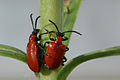 Scarlet lily beetle
 -
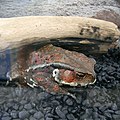 Japanese toad


