Indigo carmine: Difference between revisions
CSV import Tags: mobile edit mobile web edit |
CSV import |
||
| Line 25: | Line 25: | ||
{{medicine-stub}} | {{medicine-stub}} | ||
<gallery> | |||
File:Indigo_carmine.svg|Indigo carmine chemical structure | |||
File:Indigo_carmine.jpg|Indigo carmine solution | |||
</gallery> | |||
Latest revision as of 01:26, 18 February 2025
Indigo Carmine, also known by its chemical name 5,5'-Indigodisulfonic acid sodium salt, is a synthetic dye used in various medical and industrial applications. Its primary use in medicine is as a diagnostic tool, particularly in surgeries and endoscopic procedures, to highlight bodily structures and fluids. This article will delve into the properties, medical applications, and safety considerations of Indigo Carmine, providing a comprehensive overview of its significance in the medical field.
Properties[edit]
Indigo Carmine is characterized by its deep blue color, making it highly visible against bodily tissues and fluids. It is water-soluble, allowing for easy administration and distribution within the body. The dye has the chemical formula C16H8N2Na2O8S2 and a molecular weight of 466.36 g/mol. Its solubility in water and distinctive color are key to its utility in medical diagnostics.
Medical Applications[edit]
The primary medical application of Indigo Carmine is in the visualization of urinary tract structures during surgical procedures. It is administered intravenously and excreted by the kidneys, coloring the urine blue. This property is utilized in Cystoscopy and Ureteroscopy procedures to confirm the integrity of the urinary tract, identify ureteral orifices, and ensure that the kidneys are functioning properly.
Another significant application is in the evaluation of the fallopian tubes during fertility assessments. The dye can be introduced into the uterine cavity, and its passage through the fallopian tubes can be observed, aiding in the diagnosis of tubal patency.
Indigo Carmine is also used in colorectal surgery to detect leaks from bowel anastomoses. By injecting the dye into the rectum, surgeons can identify leaks in the surgical connections between sections of the bowel.
Safety Considerations[edit]
While Indigo Carmine is generally considered safe for use in medical diagnostics, there are potential side effects and contraindications to be aware of. Adverse reactions may include nausea, vomiting, and allergic reactions, ranging from mild to severe anaphylaxis. It is contraindicated in patients with known hypersensitivity to the dye. As with any medical procedure involving contrast agents, patient history and potential allergies should be thoroughly reviewed prior to administration.
Regulatory Status[edit]
Indigo Carmine is approved by various regulatory bodies, including the Food and Drug Administration (FDA) in the United States, for use as a diagnostic agent. Its safety and efficacy have been evaluated in numerous clinical trials and studies, supporting its continued use in medical practice.
Conclusion[edit]
Indigo Carmine remains a valuable tool in the medical field, particularly in surgeries and diagnostic procedures involving the urinary tract, fallopian tubes, and gastrointestinal system. Its unique properties and applications highlight the importance of synthetic dyes in enhancing the visibility of bodily structures and fluids, thereby aiding in diagnosis and treatment. As with any medical agent, awareness of its potential side effects and contraindications is essential to ensure patient safety.

-
 Indigo carmine chemical structure
 -
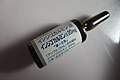 Indigo carmine solution


