Paraveterinary worker: Difference between revisions
CSV import Tags: mobile edit mobile web edit |
CSV import |
||
| Line 37: | Line 37: | ||
{{Medicine-stub}} | {{Medicine-stub}} | ||
== Paraveterinary worker == | |||
<gallery> | |||
File:US_Navy_110222-N-KF478-102_Dental_officers_prepare_a_sedated_U.S._Customs_and_Border_Protection_working_dog_for_a_root_canal.jpg|Dental officers prepare a sedated U.S. Customs and Border Protection working dog for a root canal | |||
File:Veterinary_technician_logo.jpg|Veterinary technician logo | |||
</gallery> | |||
Latest revision as of 01:22, 18 February 2025
Paraveterinary Worker
A Paraveterinary Worker is a professional who assists veterinarians in the care and treatment of animals. They play a crucial role in the veterinary field, providing support in various tasks that range from clinical procedures to administrative duties. Paraveterinary workers are known by several other titles, including veterinary nurse, veterinary technician, and animal health technician, depending on the country and specific job functions.
Roles and Responsibilities[edit]
Paraveterinary workers are involved in a wide range of activities to support animal health and welfare. Their responsibilities may include:
- Conducting clinical procedures under the supervision of a veterinarian, such as administering medications, collecting blood samples, and preparing animals for surgery.
- Providing nursing care to sick and injured animals, including monitoring vital signs, dressing wounds, and assisting in rehabilitation.
- Performing laboratory tests to help diagnose animal diseases.
- Operating and maintaining medical equipment, such as X-ray machines and ultrasound scanners.
- Assisting in the management of animal care facilities, including record-keeping, scheduling appointments, and communicating with animal owners.
- Educating pet owners on animal health, nutrition, and welfare.
Education and Certification[edit]
The education and certification requirements for paraveterinary workers vary by country and region. Typically, a diploma or associate degree in veterinary technology or a related field is required. These programs provide both theoretical knowledge and practical skills in animal care, surgical assistance, laboratory techniques, and pharmacology.
After completing their education, paraveterinary workers may need to pass a certification or licensing exam to practice professionally. The specific requirements for certification differ globally, with organizations such as the National Association of Veterinary Technicians in America (NAVTA) in the United States offering credentialing for veterinary technicians.
Work Environment[edit]
Paraveterinary workers are employed in a variety of settings, including:
- Veterinary clinics and hospitals
- Animal shelters and rescue organizations
- Research laboratories
- Zoos and wildlife facilities
- Educational institutions
Their work often requires physical stamina and may involve exposure to risks such as animal bites, scratches, and infectious diseases. Paraveterinary workers must also possess strong communication skills to effectively interact with veterinarians, pet owners, and other members of the animal care team.
Challenges and Rewards[edit]
Working as a paraveterinary worker can be both challenging and rewarding. It requires a deep compassion for animals, a commitment to their welfare, and the ability to cope with the emotional demands of dealing with sick and injured animals. However, the role offers the satisfaction of making a positive impact on animal health and contributing to the bond between pets and their owners.
Future Outlook[edit]
The demand for paraveterinary workers is expected to grow as the pet population increases and the importance of animal healthcare continues to rise. Advances in veterinary medicine and technology also contribute to the expanding scope of duties for paraveterinary workers, offering opportunities for specialization and career advancement.

Paraveterinary worker[edit]
-
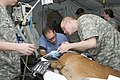 Dental officers prepare a sedated U.S. Customs and Border Protection working dog for a root canal
 -
 Veterinary technician logo


