Aedes africanus: Difference between revisions
CSV import |
CSV import |
||
| Line 36: | Line 36: | ||
[[Category:Insects of Africa]] | [[Category:Insects of Africa]] | ||
[[Category:Vectors of human pathogens]] | [[Category:Vectors of human pathogens]] | ||
<gallery> | |||
File:Culex_mosquito_life_cycle_en.svg|Aedes africanus life cycle | |||
File:Aedes_aegypti_bloodfeeding_CDC_Gathany.jpg|Aedes africanus bloodfeeding | |||
</gallery> | |||
Latest revision as of 01:08, 18 February 2025
Aedes africanus


Aedes africanus is a species of mosquito belonging to the genus Aedes. This species is primarily found in Africa and is known for its role in the transmission of various arboviruses, including the yellow fever virus.
Description[edit]
Aedes africanus is a small to medium-sized mosquito with distinct morphological features typical of the Aedes genus. The adults have a characteristic pattern of white and black scales on their bodies and legs, which aids in their identification.
Life Cycle[edit]
The life cycle of Aedes africanus follows the typical mosquito development stages: egg, larva, pupa, and adult. The eggs are laid in small collections of water, often in tree holes or other natural containers. The larvae are aquatic and undergo several molts before becoming pupae. The pupae then transform into adult mosquitoes, completing the cycle.
Habitat[edit]
Aedes africanus is predominantly found in forested areas of Africa. It is adapted to breeding in natural containers such as tree holes, which are abundant in these environments. The species is also known to inhabit areas close to human settlements, increasing the risk of disease transmission.
Medical Importance[edit]
Aedes africanus is a vector for several important arboviruses. It is notably involved in the transmission of the yellow fever virus, which can cause severe disease in humans. The mosquito's role in the transmission of other viruses, such as dengue and chikungunya, is also of concern in certain regions.
Control Measures[edit]
Controlling Aedes africanus populations is crucial for preventing the spread of the diseases they transmit. Strategies include eliminating breeding sites by removing standing water, using insecticides, and implementing biological control methods. Public health campaigns often focus on educating communities about the importance of mosquito control.
Related pages[edit]
Gallery[edit]
-
 Diagram of mosquito life cycle
 -
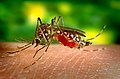 Aedes aegypti, a related species, feeding on blood
-
Aedes africanus life cycle
-
Aedes africanus bloodfeeding
