Irvingia gabonensis: Difference between revisions
CSV import |
CSV import |
||
| Line 28: | Line 28: | ||
{{tree-stub}} | {{tree-stub}} | ||
{{medicine-stub}} | {{medicine-stub}} | ||
<gallery> | |||
File:Ogbono_(Irvingia_gabonensis).jpg|Irvingia gabonensis fruit | |||
File:Ndo'o_(en_pain).jpg|Ndo'o (en pain) | |||
</gallery> | |||
Latest revision as of 00:55, 18 February 2025
Irvingia gabonensis is a species of African trees in the genus Irvingia, which is known for its edible fruit and seeds. It is also known by a variety of common names such as wild mango, African mango, or bush mango.
Description[edit]
Irvingia gabonensis trees are evergreen, reaching heights of 40 to 60 feet. The tree produces a fleshy fruit, which is similar to a mango. The fruit is green when unripe, turning a bright orange-yellow when ripe. The fruit contains a single large seed, which is where the valuable Irvingia nut is found.
Distribution and habitat[edit]
Irvingia gabonensis is native to the tropical rainforests of West Africa and Central Africa. It is predominantly found in countries such as Nigeria, Cameroon, Côte d'Ivoire, and Gabon. The tree prefers a humid, tropical climate and is often found near rivers and streams.
Uses[edit]
The fruit of the Irvingia gabonensis tree is consumed fresh, while the seed is often used in African cuisine for its high fat and protein content. The seed is also ground into a powder and used as a thickening agent in soups and stews. In addition to its culinary uses, Irvingia gabonensis has been investigated for potential medicinal properties, particularly in relation to obesity, diabetes, and high cholesterol.
Cultivation[edit]
Cultivation of Irvingia gabonensis is relatively straightforward, with the tree being propagated from seed. The tree is tolerant of a range of soil types, provided they are well-drained. It prefers a position in full sun or partial shade.
Conservation[edit]
While Irvingia gabonensis is not currently listed as threatened or endangered, habitat loss due to deforestation and over-harvesting for timber and food are potential threats to the species.
See also[edit]


-
 Irvingia gabonensis fruit
 -
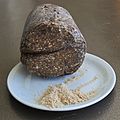 Ndo'o (en pain)
.jpg)
.jpg)
