Deinococcus: Difference between revisions
CSV import |
CSV import |
||
| Line 55: | Line 55: | ||
[[Category:Extremophiles]] | [[Category:Extremophiles]] | ||
[[Category:Radiation-resistant microorganisms]] | [[Category:Radiation-resistant microorganisms]] | ||
<gallery> | |||
File:Deinococcus_radiodurans.jpg|Deinococcus radiodurans | |||
File:Deinococcus_genomes_compared.png|Deinococcus genomes compared | |||
</gallery> | |||
Latest revision as of 00:55, 18 February 2025
Genus of bacteria known for their resistance to extreme conditions
Deinococcus is a genus of bacteria within the family Deinococcaceae, known for their remarkable resistance to extreme environmental conditions, particularly ionizing radiation, desiccation, and oxidative stress. The most well-known species within this genus is Deinococcus radiodurans, often referred to as "Conan the Bacterium" due to its extraordinary resilience.
Characteristics[edit]
Deinococcus species are Gram-positive bacteria, although they possess a complex cell wall structure that is atypical for Gram-positive organisms. They are non-motile, non-spore-forming, and typically form tetrads. The cell wall of Deinococcus is rich in peptidoglycan, and the outer membrane contains unusual lipids and carotenoids, which contribute to their pink to red pigmentation.
Genomic Features[edit]
The genome of Deinococcus radiodurans is highly redundant, with multiple copies of its genome present in each cell. This redundancy is thought to play a crucial role in its ability to repair DNA damage caused by radiation. The genome encodes a robust set of DNA repair mechanisms, including homologous recombination, non-homologous end joining, and base excision repair.
Resistance Mechanisms[edit]
Deinococcus species exhibit resistance to ionizing radiation levels that are lethal to most other forms of life. This resistance is attributed to several factors:
- Efficient DNA Repair: Deinococcus can repair double-strand breaks in its DNA with high fidelity.
- Antioxidant Systems: The bacteria possess powerful antioxidant systems that protect against oxidative damage.
- Protein Protection: Proteins in Deinococcus are protected from radiation-induced damage, maintaining cellular functions even under stress.
Ecology and Habitat[edit]
Deinococcus species are found in a variety of environments, including soil, dust, and extreme habitats such as hot springs and deserts. Their ability to withstand desiccation allows them to survive in arid conditions, while their radiation resistance enables them to persist in environments with high levels of natural radiation.
Applications[edit]
Due to their resilience, Deinococcus species have potential applications in bioremediation, particularly in the cleanup of radioactive waste. Their ability to degrade organic pollutants while withstanding radiation makes them suitable candidates for such tasks.
Species[edit]
The genus Deinococcus includes several species, with Deinococcus radiodurans being the most studied. Other notable species include:
Also see[edit]
References[edit]
<references group="" responsive="1"></references>
External links[edit]
-
 Deinococcus radiodurans
 -
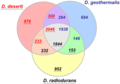 Deinococcus genomes compared


