Potato grouper: Difference between revisions
CSV import |
CSV import |
||
| Line 27: | Line 27: | ||
{{fish-stub}} | {{fish-stub}} | ||
{{food-stub}} | {{food-stub}} | ||
<gallery> | |||
File:Potato_grouper.jpg|Potato grouper | |||
File:Epinephelus_tukula_1866.jpg|Epinephelus tukula illustration from 1866 | |||
File:Epinephelus_tukula.jpg|Epinephelus tukula | |||
File:Gaussian_distribution_2.jpg|Gaussian distribution | |||
</gallery> | |||
Revision as of 00:42, 18 February 2025
Potato grouper (Epinephelus tukula) is a species of marine fish in the family Serranidae. It is known for its large size and is part of the grouper family. The potato grouper is native to the Indian Ocean and the western Pacific Ocean.
Description
The potato grouper is a large fish that can reach a length of up to 2 meters and a weight of up to 100 kg. It has a robust body with a standard grouper shape. The color of the body varies from brown to grey and is covered with large, round, dark spots that give it its name, as they resemble a potato.
Habitat and Distribution
Potato groupers are found in the tropical and subtropical waters of the Indian and Pacific Oceans. They inhabit rocky reefs and coral areas, usually at depths of 10 to 150 meters. They are solitary creatures and are often found in caves or overhangs.
Diet and Behavior
Potato groupers are carnivorous, feeding mainly on other fish and invertebrates. They are ambush predators, lying in wait for their prey and then striking with speed and power.
Conservation Status
The potato grouper is listed as Near Threatened on the IUCN Red List due to overfishing and habitat loss. It is also a popular species in the aquarium trade, which puts additional pressure on wild populations.
References
<references />

-
Potato grouper
-
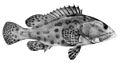 Epinephelus tukula illustration from 1866
 -
 Epinephelus tukula
 -
Gaussian distribution


