Acral nevus: Difference between revisions
CSV import |
CSV import |
||
| Line 29: | Line 29: | ||
[[Category:Dermatology]] | [[Category:Dermatology]] | ||
[[Category:Melanocytic nevi and neoplasms]] | [[Category:Melanocytic nevi and neoplasms]] | ||
== Acral nevus == | |||
<gallery> | |||
File:Skin_Tumors-P9071282.jpg | |||
File:Skin_Tumors-P9071281.jpg | |||
</gallery> | |||
Revision as of 02:06, 17 February 2025
Acral nevus
An acral nevus is a type of melanocytic nevus that occurs on the acral areas of the body, which include the palms, soles, and nail beds. These nevi are generally benign and are characterized by their distinct location on the body.
Characteristics
Acral nevi are typically small, pigmented lesions that can vary in color from light brown to black. They are usually round or oval in shape and have well-defined borders. The texture of an acral nevus can be smooth or slightly raised.
Histology
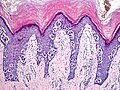
Under the microscope, acral nevi show nests of melanocytes at the dermoepidermal junction. These melanocytes are often arranged in a pattern that is distinct from nevi found on other parts of the body. The histological features help differentiate acral nevi from other pigmented lesions, such as acral lentiginous melanoma.
Differential Diagnosis
The primary concern with acral nevi is distinguishing them from melanoma, particularly acral lentiginous melanoma, which can also occur in the same locations. Dermatologists often use dermoscopy to examine the patterns and structures within the nevus to aid in diagnosis.
Management
Most acral nevi do not require treatment unless there are changes in size, shape, or color, which could indicate malignant transformation. Regular monitoring and biopsy may be recommended if there are any suspicious changes.
Related pages
Gallery
-
 Acral nevus on the sole of the foot
 -
 Close-up of an acral nevus


