Tetramethylcyclopropylfentanyl: Difference between revisions
CSV import Tags: mobile edit mobile web edit |
CSV import Tags: mobile edit mobile web edit |
||
| Line 27: | Line 27: | ||
{{pharmacology-stub}} | {{pharmacology-stub}} | ||
<gallery> | |||
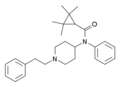
File:Tetramethylcyclopropylfentanyl_structure.png|Structure of Tetramethylcyclopropylfentanyl | |||
</gallery> | |||
Latest revision as of 02:05, 17 February 2025
Tetramethylcyclopropylfentanyl is a potent synthetic opioid that is part of the larger fentanyl family of drugs. It is a designer drug, meaning it is synthesized in a laboratory and is not naturally occurring.
Chemistry[edit]
Tetramethylcyclopropylfentanyl is a cyclopropyl derivative of fentanyl, which itself is a synthetic opioid analgesic. The chemical formula for tetramethylcyclopropylfentanyl is C24H30N2O. It is a white, crystalline powder at room temperature.
Pharmacology[edit]
Like other opioids, tetramethylcyclopropylfentanyl works by binding to the mu-opioid receptor in the brain. This receptor is responsible for the analgesic effects of opioids, as well as their potential for addiction and overdose. Tetramethylcyclopropylfentanyl is believed to be several times more potent than morphine, although exact potency can vary depending on the specific formulation and route of administration.
Effects[edit]
The effects of tetramethylcyclopropylfentanyl are similar to those of other opioids and can include pain relief, euphoria, sedation, and respiratory depression. Because of its high potency, there is a significant risk of overdose, which can lead to death.
Legal Status[edit]
Tetramethylcyclopropylfentanyl is a controlled substance in many countries, including the United States, where it is classified as a Schedule I drug under the Controlled Substances Act. This means it has a high potential for abuse and no accepted medical use.
See Also[edit]
References[edit]
<references />

-
 Structure of Tetramethylcyclopropylfentanyl

