Etoxadrol: Difference between revisions
CSV import |
CSV import |
||
| Line 29: | Line 29: | ||
{{medicine-stub}} | {{medicine-stub}} | ||
<gallery> | |||
File:Chemical_Structures.png|Chemical Structures | |||
File:NMDA_Etoxadrol.png|NMDA Etoxadrol | |||
</gallery> | |||
Latest revision as of 02:04, 17 February 2025
Etoxadrol is a dissociative anesthetic that belongs to the arylcyclohexylamine class of compounds, which includes well-known substances such as phencyclidine (PCP) and ketamine. It is known for its potent psychoactive properties, which can induce states of dissociation, analgesia, and anesthesia. Despite its potential for research in understanding the mechanisms of dissociative anesthetics, etoxadrol has limited clinical use due to its side effects and potential for abuse.
Pharmacology[edit]
Etoxadrol acts primarily as an NMDA receptor antagonist, blocking the action of the neurotransmitter glutamate at the NMDA receptor sites in the brain. This blockade leads to the dissociative effects characteristic of this class of drugs. The NMDA receptor is involved in processes such as pain sensation, memory, and emotion, explaining the broad range of effects etoxadrol can have on perception, mood, and consciousness.
Clinical Use[edit]
Due to its potent effects and the risk of side effects such as hallucinations, delirium, and potential for dependence, etoxadrol has not been widely adopted in clinical practice. Its use has been largely confined to experimental settings, where it has been studied for its effects on the brain and potential applications in treating conditions such as chronic pain, depression, and drug addiction. However, the therapeutic value of etoxadrol remains under investigation, and it is not currently approved for any medical use.
Legal Status[edit]
The legal status of etoxadrol varies by country, but it is often classified as a controlled substance due to its similarity to other arylcyclohexylamines with known abuse potential. This classification restricts its availability and use to authorized research settings.
Research[edit]
Research on etoxadrol has contributed to a broader understanding of the NMDA receptor and its role in pain, mood regulation, and the effects of dissociative anesthetics. Studies have explored its potential therapeutic applications, but the development of etoxadrol as a medication has been limited by its side effects and the risk of abuse.
See Also[edit]
References[edit]
<references />

-
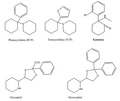 Chemical Structures
 -
 NMDA Etoxadrol


