Parotitis: Difference between revisions
CSV import |
CSV import |
||
| Line 25: | Line 25: | ||
[[Category:RTT]] | [[Category:RTT]] | ||
{{stub}} | {{stub}} | ||
<gallery> | |||
File:Parotitis_svg_hariadhi.svg|Illustration of parotitis by Hari Adhi | |||
File:Gray781.png|Anatomical diagram from Gray's Anatomy | |||
</gallery> | |||
Revision as of 01:58, 17 February 2025
Parotitis is an inflammation of one or both parotid glands, the major salivary glands located on either side of the face, in humans. The parotid gland is the salivary gland most commonly affected by inflammation.
Causes
Parotitis is most often caused by a bacterial or viral infection. Dehydration, which can occur in those who are critically ill from other causes, can cause parotitis. Other causes include local autoimmune phenomena, as in Sjögren's syndrome, and obstruction of the parotid duct, either by a salivary stone (a sialolith) or a tumor.
Symptoms
Symptoms of parotitis can include: swelling of the face, pain in the face that may be worsened by eating, fever, and a foul-tasting fluid in the mouth.
Diagnosis
Diagnosis of parotitis is made on the basis of the clinical presentation, and can be confirmed by sending a sample of the fluid expressed from the parotid duct for culture.
Treatment
Treatment of parotitis is determined by the cause. If the cause is bacterial, then antibiotics are usually prescribed. If the cause is viral, then the treatment is supportive (pain control and hydration). If the cause is an obstruction, then the obstruction is usually removed.
See also
References
<references />
 | This medical article is a stub. You can help WikiMD by expanding the page. |
-
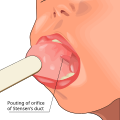 Illustration of parotitis by Hari Adhi
 -
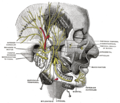 Anatomical diagram from Gray's Anatomy


