-Pinene: Difference between revisions
CSV import |
CSV import Tags: mobile edit mobile web edit |
||
| Line 33: | Line 33: | ||
[[Category:Terpenes]] | [[Category:Terpenes]] | ||
<gallery> | |||
File:Alpha-Pinene_Isomers.svg|Isomers of _-Pinene | |||
File:AlphaPinene_rxns.png|Reactions involving _-Pinene | |||
</gallery> | |||
Latest revision as of 01:57, 17 February 2025
_-Pinene[edit]

_-Pinene is a naturally occurring monoterpene and one of the most abundant compounds released by forest trees. It is a colorless liquid soluble in alcohol, but not in water. _-Pinene is a major component of turpentine and has a woody-green pine-like smell.
Chemical Properties[edit]
_-Pinene is a bicyclic monoterpene, which means it consists of two isoprene units and contains two rings. Its chemical formula is C__H__. The structure of _-Pinene includes a six-membered ring and a four-membered ring, which contributes to its reactivity and volatility.
Occurrence[edit]
_-Pinene is found in the essential oils of many plants, particularly in coniferous trees such as pine, fir, and spruce. It is also present in the oils of some herbs, such as rosemary and dill.
Uses[edit]
_-Pinene is used in the production of synthetic camphor, perfumes, and as a flavoring agent. It is also used in the manufacture of resins, adhesives, and paints.
Biological Activity[edit]
_-Pinene has been studied for its potential anti-inflammatory, antimicrobial, and antioxidant properties. It is believed to contribute to the therapeutic effects of aromatherapy and is a component of many essential oils used in traditional medicine.
Safety[edit]
While _-Pinene is generally recognized as safe when used in food and cosmetics, it can be an irritant in high concentrations. Proper handling and storage are necessary to prevent exposure to its concentrated form.
Related Pages[edit]
-
 Isomers of _-Pinene
 -
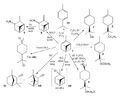 Reactions involving _-Pinene


