Geochronology: Difference between revisions
CSV import |
CSV import Tags: mobile edit mobile web edit |
||
| Line 39: | Line 39: | ||
{{Geology-stub}} | {{Geology-stub}} | ||
<gallery> | |||
File:Geological_time_spiral.png|Geological time spiral | |||
File:Icelandic_tephra.JPG|Icelandic tephra | |||
</gallery> | |||
Latest revision as of 01:50, 17 February 2025
Geochronology is the science of determining the age of rocks, fossils, and sediments using signatures inherent in the rocks themselves. The ages can be relative, where the age of one entity is determined in relation to another, or absolute, where a numerical age is assigned to an event or formation. Geochronology is an essential tool in Earth science, archaeology, and paleontology for understanding the timing and sequence of events in the history of the Earth and the evolution of life.
Methods[edit]
Geochronology employs a variety of dating methods to determine the age of geological materials. These methods can be broadly classified into two categories: relative dating and absolute dating.
Relative Dating[edit]
Relative dating methods determine the sequence of events relative to one another but do not provide numerical dates. Key techniques include:
- Stratigraphy: Based on the principle of superposition, where younger layers of rock are deposited on top of older layers.
- Biostratigraphy: Utilizes the distribution of fossils within sedimentary rocks to correlate layers of similar ages across different locations.
- Cross-cutting relationships: Involves the principle that an intrusive rock is younger than the rock it cuts across.
Absolute Dating[edit]
Absolute dating methods provide a numerical age or range in contrast with relative dating. These include:
- Radiometric dating: Measures the decay of radioactive isotopes within rocks and minerals. Key methods include Uranium-Lead dating, Potassium-Argon dating, and Carbon-14 dating.
- Luminescence dating: Determines the time elapsed since mineral grains were last exposed to sunlight or heat.
- Ice core dating: Uses the layering of ice cores from glaciers to date events and environmental changes.
Applications[edit]
Geochronology has a wide range of applications, including:
- Dating of geological events such as volcanic eruptions, mountain building, and glaciations.
- Understanding the timing and sequence of biological evolution and the fossil record.
- Reconstructing past climates and environmental conditions.
- Dating archaeological sites and artifacts to study human history.
Challenges[edit]
Despite its utility, geochronology faces several challenges:
- Dating accuracy and precision can vary depending on the method used and the material being dated.
- Some materials or events may be difficult to date directly, requiring indirect methods or correlation with dated materials.
- Geological processes such as erosion, metamorphism, and tectonic activity can alter or obliterate dating signals.
See Also[edit]

-
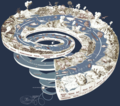 Geological time spiral
 -
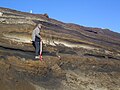 Icelandic tephra


