Catumaxomab: Difference between revisions
CSV import Tags: mobile edit mobile web edit |
CSV import Tags: mobile edit mobile web edit |
||
| Line 26: | Line 26: | ||
[[Category:Monoclonal antibodies]] | [[Category:Monoclonal antibodies]] | ||
{{Medicine-stub}} | {{Medicine-stub}} | ||
<gallery> | |||
File:Catumaxomab_mechanism.svg|Mechanism of action of Catumaxomab | |||
File:Catumaxomab_structure.svg|Structure of Catumaxomab | |||
</gallery> | |||
Revision as of 01:49, 17 February 2025
Catumaxomab is a rat-mouse hybrid monoclonal antibody designed for the treatment of cancer. It represents a unique approach in immunotherapy, targeting the EpCAM (epithelial cell adhesion molecule) on cancer cells and the CD3 receptor on T-cells. This dual targeting mechanism facilitates the direct and selective activation of the immune system against cancer cells, making catumaxomab a pioneering agent in cancer treatment.
Mechanism of Action
Catumaxomab operates through a tri-functional mechanism. Firstly, it binds to the EpCAM antigen expressed on the surface of tumor cells. Secondly, it engages CD3-expressing T-cells. Lastly, it recruits accessory immune cells, such as macrophages, natural killer cells, and dendritic cells, through its Fc region. This tri-functional engagement initiates a complex immune response that leads to the destruction of tumor cells.
Clinical Applications
Catumaxomab has been primarily used in the treatment of malignant ascites, a condition characterized by the accumulation of fluid in the peritoneal cavity due to cancer. Malignant ascites is most commonly associated with cancers of the ovary, breast, colon, and pancreas. The administration of catumaxomab has shown to significantly improve the quality of life for patients suffering from this condition by reducing the need for paracentesis, a procedure to remove excess fluid.
Approval and Usage
Catumaxomab received conditional approval from the European Medicines Agency (EMA) in 2009 for the treatment of malignant ascites in patients with EpCAM-positive carcinomas when standard therapy is not available or no longer feasible. However, it is important to note that as of my last update, catumaxomab has been withdrawn from the market due to commercial reasons.
Side Effects
The administration of catumaxomab is associated with a range of side effects, the most common of which include cytokine release syndrome (CRS), nausea, vomiting, and abdominal pain. CRS is a systemic inflammatory response that can occur after the infusion of immunotherapy agents like catumaxomab. Management of these side effects is crucial for the well-being of the patient and the successful administration of the therapy.
Future Directions
Research continues in the field of immunotherapy with molecules similar to catumaxomab, aiming to improve efficacy and reduce side effects. The concept of bispecific antibodies, capable of engaging two different targets simultaneously, remains a promising avenue in cancer therapy.
See Also

-
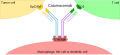 Mechanism of action of Catumaxomab
 -
 Structure of Catumaxomab


