Endobronchial valve: Difference between revisions
CSV import |
CSV import |
||
| Line 24: | Line 24: | ||
{{medicine-stub}} | {{medicine-stub}} | ||
<gallery> | |||
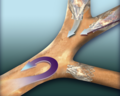
File:Endobronchial_valves_placed_in_airways.png|Endobronchial valves placed in airways | |||
</gallery> | |||
Latest revision as of 22:03, 16 February 2025
Endobronchial valve (EBV) is a medical device used in the treatment of severe emphysema, a type of chronic obstructive pulmonary disease (COPD). The device is designed to improve lung function, reduce breathlessness, and enhance the quality of life for patients with emphysema by isolating the diseased portion of the lung, thereby reducing its volume and allowing the healthier parts of the lung to function more effectively.
Overview[edit]
Endobronchial valves are small, one-way valves that are placed inside the airways (bronchi) of the lung during a minimally invasive procedure called bronchoscopy. These valves allow air to exit the diseased part of the lung without letting air back in. This process is known as lung volume reduction. Over time, the treated portion of the lung collapses, making more room for the expansion of healthier lung tissue.
Indications[edit]
The primary indication for the use of endobronchial valves is for patients with severe emphysema who have not responded adequately to medical management, including medications and pulmonary rehabilitation. Candidates for this procedure typically have heterogeneous emphysema with areas of the lung that are more damaged than others and little to no collateral ventilation in the target lobe.
Procedure[edit]
The placement of endobronchial valves is performed during a bronchoscopy, which is a procedure that allows doctors to look inside the airways of the lungs using a thin, flexible tube called a bronchoscope. The procedure is usually done under sedation or general anesthesia. Using the bronchoscope, the physician navigates to the targeted area of the lung and places the valves in the airways leading to the diseased part of the lung.
Benefits[edit]
Patients who undergo this procedure may experience significant improvements in lung function, exercise capacity, and quality of life. The reduction in lung volume can lead to a decrease in breathlessness, making it easier for patients to perform daily activities.
Risks and Complications[edit]
As with any medical procedure, the placement of endobronchial valves carries certain risks. These may include pneumothorax (collapsed lung), exacerbation of COPD symptoms, pneumonia, and, in rare cases, death. However, for many patients, the potential benefits of the procedure outweigh the risks.
Conclusion[edit]
Endobronchial valves represent a significant advancement in the treatment of severe emphysema. By providing a minimally invasive option for lung volume reduction, they offer hope to patients who have limited treatment options. As with any medical intervention, careful patient selection and thorough discussion of the potential risks and benefits are essential.

-
 Endobronchial valves placed in airways

