Arctogadus: Difference between revisions
CSV import Tags: mobile edit mobile web edit |
CSV import |
||
| Line 1: | Line 1: | ||
{{Short description|Genus of fish}} | |||
{{Taxobox | |||
| name = Arctogadus | |||
| image = Arctogadus glacialis.jpg | |||
| image_caption = ''Arctogadus glacialis'' | |||
| regnum = [[Animalia]] | |||
| phylum = [[Chordata]] | |||
| classis = [[Actinopterygii]] | |||
| ordo = [[Gadiformes]] | |||
| familia = [[Gadidae]] | |||
| genus = '''''Arctogadus''''' | |||
| genus_authority = [[Dryagin]], 1932 | |||
}} | |||
'''''Arctogadus''''' is a genus of [[cod]]-like [[fish]] in the family [[Gadidae]]. This genus is known for its adaptation to cold Arctic waters. It includes species that are important both ecologically and commercially in the Arctic region. | |||
The genus '' | ==Species== | ||
The genus ''Arctogadus'' comprises two recognized species: | |||
* '''''[[Arctogadus glacialis]]''''', commonly known as the [[Arctic cod]]. | |||
* '''''[[Arctogadus borisovi]]''''', known as the [[East Siberian cod]]. | |||
==Description== | |||
Members of the genus ''Arctogadus'' are characterized by their elongated bodies and a single [[barbel]] on the chin. They have a streamlined shape that aids in swimming through the icy waters of the Arctic. The coloration of these fish is typically a pale, silvery hue, which provides camouflage against the ice and snow. | |||
==Habitat== | |||
''Arctogadus'' species are found in the cold waters of the [[Arctic Ocean]], particularly around the [[Greenland]] and [[Siberian]] coasts. They inhabit both shallow coastal areas and deeper offshore waters, often under the ice. | |||
== | ==Ecology== | ||
These fish play a crucial role in the Arctic ecosystem. They are a primary food source for larger predators such as [[seals]], [[whales]], and [[polar bears]]. ''Arctogadus'' species are also important for local fisheries, providing sustenance for indigenous communities. | |||
==Adaptations== | |||
''Arctogadus'' species have several adaptations that allow them to survive in extreme cold. They possess antifreeze proteins in their blood, which prevent ice crystals from forming. Their metabolism is adapted to function efficiently at low temperatures, and they have a high fat content that provides insulation and energy reserves. | |||
== | ==Conservation== | ||
While not currently considered endangered, ''Arctogadus'' species face threats from climate change, which is rapidly altering their Arctic habitat. Melting ice and changing sea temperatures could impact their distribution and abundance. | |||
==Related pages== | |||
* [[Cod]] | |||
* [[Arctic Ocean]] | |||
* [[Gadidae]] | |||
* [[Marine biology]] | |||
== | ==Gallery== | ||
<gallery> | |||
File:Gray506.svg|Diagram of the aortic arch | |||
File:Gray505.png|Illustration of the human heart | |||
File:WIKI_IMAGE_I_FINAL.png|Image of ''Arctogadus glacialis'' | |||
File:Gray490.png|Anatomy of the fish | |||
File:Gray793.png|Fish skeletal structure | |||
</gallery> | |||
[[Category:Gadidae]] | |||
[[Category:Fish of the Arctic Ocean]] | [[Category:Fish of the Arctic Ocean]] | ||
[[Category: | [[Category:Marine fish genera]] | ||
Revision as of 19:08, 11 February 2025
Genus of fish
Arctogadus is a genus of cod-like fish in the family Gadidae. This genus is known for its adaptation to cold Arctic waters. It includes species that are important both ecologically and commercially in the Arctic region.
Species
The genus Arctogadus comprises two recognized species:
- Arctogadus glacialis, commonly known as the Arctic cod.
- Arctogadus borisovi, known as the East Siberian cod.
Description
Members of the genus Arctogadus are characterized by their elongated bodies and a single barbel on the chin. They have a streamlined shape that aids in swimming through the icy waters of the Arctic. The coloration of these fish is typically a pale, silvery hue, which provides camouflage against the ice and snow.
Habitat
Arctogadus species are found in the cold waters of the Arctic Ocean, particularly around the Greenland and Siberian coasts. They inhabit both shallow coastal areas and deeper offshore waters, often under the ice.
Ecology
These fish play a crucial role in the Arctic ecosystem. They are a primary food source for larger predators such as seals, whales, and polar bears. Arctogadus species are also important for local fisheries, providing sustenance for indigenous communities.
Adaptations
Arctogadus species have several adaptations that allow them to survive in extreme cold. They possess antifreeze proteins in their blood, which prevent ice crystals from forming. Their metabolism is adapted to function efficiently at low temperatures, and they have a high fat content that provides insulation and energy reserves.
Conservation
While not currently considered endangered, Arctogadus species face threats from climate change, which is rapidly altering their Arctic habitat. Melting ice and changing sea temperatures could impact their distribution and abundance.
Related pages
Gallery
-
 Diagram of the aortic arch
 -
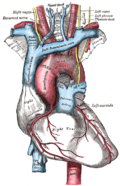 Illustration of the human heart
 -
 Image of Arctogadus glacialis
 -
 Anatomy of the fish
 -
 Fish skeletal structure


