Arbekacin: Difference between revisions
CSV import |
CSV import Tags: mobile edit mobile web edit |
||
| Line 1: | Line 1: | ||
{{Short description|Autoantibodies that bind to contents of the cell nucleus}} | |||
'''Antinuclear antibodies''' (ANAs) are [[autoantibodies]] that bind to contents of the [[cell nucleus]]. They are present in a variety of [[autoimmune diseases]] and are often used as a diagnostic tool in [[rheumatology]]. ANAs can be detected through various laboratory techniques, most commonly by [[immunofluorescence]] on [[HEp-2 cells]]. | |||
== | ==Types of Antinuclear Antibodies== | ||
Antinuclear antibodies can be classified based on their target antigens within the nucleus. Some of the common types include: | |||
* '''Anti-dsDNA antibodies''': These target [[double-stranded DNA]] and are highly specific for [[systemic lupus erythematosus]] (SLE). | |||
* '''Anti-Smith antibodies''': These target [[Smith antigen]], a ribonucleoprotein, and are also associated with SLE. | |||
* '''Anti-Ro/SSA and Anti-La/SSB antibodies''': These are associated with [[Sjogren's syndrome]] and [[lupus]]. | |||
* '''Anti-centromere antibodies''': These are often found in [[limited scleroderma]] (CREST syndrome). | |||
* '''Anti-nucleolar antibodies''': These target nucleolar components and are associated with [[scleroderma]]. | |||
== | ==Detection Methods== | ||
The presence of ANAs is typically detected using the [[indirect immunofluorescence]] (IIF) method on HEp-2 cells. This method allows for the observation of various staining patterns that can provide clues to the specific type of ANA present. | |||
== | ===Immunofluorescence Patterns=== | ||
The immunofluorescence patterns observed in ANA testing can be classified into several types: | |||
* '''Homogeneous pattern''': Indicates antibodies against chromatin, histones, and sometimes dsDNA. | |||
* '''Speckled pattern''': Suggests antibodies against extractable nuclear antigens (ENAs) such as Smith, RNP, SSA, and SSB. | |||
* '''Nucleolar pattern''': Associated with antibodies against nucleolar components, often seen in scleroderma. | |||
* '''Centromere pattern''': Characteristic of anti-centromere antibodies, often seen in limited scleroderma. | |||
[[ | ==Clinical Significance== | ||
[[ | ANAs are a hallmark of [[autoimmune diseases]], particularly [[systemic lupus erythematosus]] (SLE), where they are present in over 95% of patients. However, they can also be found in other conditions such as [[rheumatoid arthritis]], [[scleroderma]], [[Sjogren's syndrome]], and [[mixed connective tissue disease]]. | ||
===Autoimmune Diseases Associated with ANAs=== | |||
* '''Systemic Lupus Erythematosus (SLE)''': High prevalence of ANAs, especially anti-dsDNA and anti-Smith antibodies. | |||
* '''Scleroderma''': Presence of anti-centromere and anti-nucleolar antibodies. | |||
* '''Sjogren's Syndrome''': Often associated with anti-Ro/SSA and anti-La/SSB antibodies. | |||
* '''Mixed Connective Tissue Disease (MCTD)''': Characterized by the presence of anti-U1 RNP antibodies. | |||
==Related Pages== | |||
* [[Autoimmune disease]] | |||
* [[Systemic lupus erythematosus]] | |||
* [[Rheumatology]] | |||
* [[Immunofluorescence]] | |||
==Gallery== | |||
<gallery> | |||
Main_antinuclear_antibody_patterns_on_immunofluorescence.png|Main antinuclear antibody patterns on immunofluorescence | |||
DsDNA_antibodies.jpg|dsDNA antibodies | |||
SSA_SSB_ANA.jpg|SSA and SSB antibodies | |||
ANA_-_dsDNA_antibody.png|ANA - dsDNA antibody | |||
CENTROMERE.jpg|Centromere pattern | |||
ANA-Kit.jpg|ANA testing kit | |||
ANA_Immunofluorescence.png|ANA immunofluorescence | |||
ANA_NUCLEOLAR_3.jpg|Nucleolar pattern | |||
CRITHIDIA_2.jpg|Crithidia luciliae assay | |||
LECell.jpg|LE cell | |||
</gallery> | |||
[[Category:Autoimmune diseases]] | |||
[[Category:Immunology]] | |||
Revision as of 17:57, 11 February 2025
Autoantibodies that bind to contents of the cell nucleus
Antinuclear antibodies (ANAs) are autoantibodies that bind to contents of the cell nucleus. They are present in a variety of autoimmune diseases and are often used as a diagnostic tool in rheumatology. ANAs can be detected through various laboratory techniques, most commonly by immunofluorescence on HEp-2 cells.
Types of Antinuclear Antibodies
Antinuclear antibodies can be classified based on their target antigens within the nucleus. Some of the common types include:
- Anti-dsDNA antibodies: These target double-stranded DNA and are highly specific for systemic lupus erythematosus (SLE).
- Anti-Smith antibodies: These target Smith antigen, a ribonucleoprotein, and are also associated with SLE.
- Anti-Ro/SSA and Anti-La/SSB antibodies: These are associated with Sjogren's syndrome and lupus.
- Anti-centromere antibodies: These are often found in limited scleroderma (CREST syndrome).
- Anti-nucleolar antibodies: These target nucleolar components and are associated with scleroderma.
Detection Methods
The presence of ANAs is typically detected using the indirect immunofluorescence (IIF) method on HEp-2 cells. This method allows for the observation of various staining patterns that can provide clues to the specific type of ANA present.
Immunofluorescence Patterns
The immunofluorescence patterns observed in ANA testing can be classified into several types:
- Homogeneous pattern: Indicates antibodies against chromatin, histones, and sometimes dsDNA.
- Speckled pattern: Suggests antibodies against extractable nuclear antigens (ENAs) such as Smith, RNP, SSA, and SSB.
- Nucleolar pattern: Associated with antibodies against nucleolar components, often seen in scleroderma.
- Centromere pattern: Characteristic of anti-centromere antibodies, often seen in limited scleroderma.
Clinical Significance
ANAs are a hallmark of autoimmune diseases, particularly systemic lupus erythematosus (SLE), where they are present in over 95% of patients. However, they can also be found in other conditions such as rheumatoid arthritis, scleroderma, Sjogren's syndrome, and mixed connective tissue disease.
Autoimmune Diseases Associated with ANAs
- Systemic Lupus Erythematosus (SLE): High prevalence of ANAs, especially anti-dsDNA and anti-Smith antibodies.
- Scleroderma: Presence of anti-centromere and anti-nucleolar antibodies.
- Sjogren's Syndrome: Often associated with anti-Ro/SSA and anti-La/SSB antibodies.
- Mixed Connective Tissue Disease (MCTD): Characterized by the presence of anti-U1 RNP antibodies.
Related Pages
Gallery
-
 Main antinuclear antibody patterns on immunofluorescence
 -
 dsDNA antibodies
 -
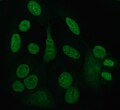 SSA and SSB antibodies
 -
 ANA - dsDNA antibody
 -
 Centromere pattern
 -
 ANA testing kit
 -
 ANA immunofluorescence
 -
 Nucleolar pattern
 -
Crithidia luciliae assay
-
LE cell


