Arizona wine: Difference between revisions
CSV import Tags: mobile edit mobile web edit |
CSV import |
||
| Line 1: | Line 1: | ||
== Apios americana == | |||
'''Apios americana''', commonly known as the American groundnut, Indian potato, or potato bean, is a perennial vine native to eastern North America. It is a member of the [[Fabaceae]] family, which is the same family that includes beans and peas. The plant is notable for its edible tubers and seeds, which have been used as a food source by Native Americans and early European settlers. | |||
== Description == | |||
''Apios americana'' is a climbing vine that can reach lengths of 1 to 6 meters. The plant has compound leaves with 5 to 7 leaflets, each leaflet being ovate to lanceolate in shape. The flowers are pea-like, typically pink to purple, and are borne in dense clusters. The plant produces elongated seed pods that contain several seeds. | |||
The most distinctive feature of ''Apios americana'' is its tubers, which grow underground in chains. These tubers are rich in starch and protein, making them a valuable food source. The tubers can vary in size and shape, often resembling small potatoes. | |||
== | == Habitat and Distribution == | ||
''Apios americana'' is found in a variety of habitats, including wetlands, riverbanks, and forest edges. It prefers moist, well-drained soils and can often be found growing in association with other wetland plants. The species is distributed throughout eastern North America, from southern Canada to the Gulf Coast of the United States. | |||
[[Category: | == Uses == | ||
[[Category: | |||
[[Category: | The tubers of ''Apios americana'' have been used as a food source for centuries. They can be boiled, roasted, or fried, and have a nutty flavor. The seeds can also be eaten, although they require cooking to remove toxins. In addition to its use as a food source, ''Apios americana'' has potential as a crop for sustainable agriculture due to its high nutritional value and ability to fix nitrogen in the soil. | ||
== Cultivation == | |||
''Apios americana'' can be cultivated in gardens and farms. It requires a support structure to climb, such as a trellis or fence. The plant prefers full sun to partial shade and moist, fertile soil. Tubers can be harvested in the fall after the plant has died back. | |||
== Related pages == | |||
* [[Fabaceae]] | |||
* [[Perennial plant]] | |||
* [[Nitrogen fixation]] | |||
* [[Native American cuisine]] | |||
== Gallery == | |||
<gallery> | |||
File:Apios_americana_in_flower_(American_groundnut;_Indian_potato)_1_(20278465435).jpg|''Apios americana'' in flower | |||
</gallery> | |||
[[Category:Fabaceae]] | |||
[[Category:Edible legumes]] | |||
[[Category:Flora of North America]] | |||
Revision as of 17:42, 11 February 2025
Apios americana
Apios americana, commonly known as the American groundnut, Indian potato, or potato bean, is a perennial vine native to eastern North America. It is a member of the Fabaceae family, which is the same family that includes beans and peas. The plant is notable for its edible tubers and seeds, which have been used as a food source by Native Americans and early European settlers.
Description
Apios americana is a climbing vine that can reach lengths of 1 to 6 meters. The plant has compound leaves with 5 to 7 leaflets, each leaflet being ovate to lanceolate in shape. The flowers are pea-like, typically pink to purple, and are borne in dense clusters. The plant produces elongated seed pods that contain several seeds.
The most distinctive feature of Apios americana is its tubers, which grow underground in chains. These tubers are rich in starch and protein, making them a valuable food source. The tubers can vary in size and shape, often resembling small potatoes.
Habitat and Distribution
Apios americana is found in a variety of habitats, including wetlands, riverbanks, and forest edges. It prefers moist, well-drained soils and can often be found growing in association with other wetland plants. The species is distributed throughout eastern North America, from southern Canada to the Gulf Coast of the United States.
Uses
The tubers of Apios americana have been used as a food source for centuries. They can be boiled, roasted, or fried, and have a nutty flavor. The seeds can also be eaten, although they require cooking to remove toxins. In addition to its use as a food source, Apios americana has potential as a crop for sustainable agriculture due to its high nutritional value and ability to fix nitrogen in the soil.
Cultivation
Apios americana can be cultivated in gardens and farms. It requires a support structure to climb, such as a trellis or fence. The plant prefers full sun to partial shade and moist, fertile soil. Tubers can be harvested in the fall after the plant has died back.
Related pages
Gallery
-
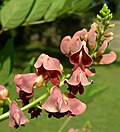 Apios americana in flower
_1_(20278465435).jpg)
