Aristocracy: Difference between revisions
CSV import Tags: mobile edit mobile web edit |
CSV import |
||
| Line 1: | Line 1: | ||
{{ | {{Short description|Opening at the tip of the root of a tooth}} | ||
''' | The '''apical foramen''' is an anatomical feature of the [[tooth]] that plays a crucial role in dental health and endodontic procedures. It is the opening at the apex, or tip, of the root of a tooth, through which the [[nerve]], [[blood vessels]], and other tissues enter the [[pulp cavity]]. | ||
== | ==Anatomy== | ||
The apical foramen is located at the end of the [[root canal]], which is the natural cavity within the root of a tooth. The size and shape of the apical foramen can vary significantly among different teeth and individuals. Typically, it is a small opening, but its dimensions can change due to [[tooth development]], [[age]], or [[pathological conditions]]. | |||
==Function== | |||
The primary function of the apical foramen is to allow the passage of the [[neurovascular bundle]] that supplies the dental pulp. This bundle includes the [[dental artery]], [[dental vein]], and [[dental nerve]], which are essential for the nourishment, sensation, and health of the tooth. | |||
== | ==Clinical Significance== | ||
In [[endodontics]], the apical foramen is a critical landmark. During [[root canal therapy]], it is important to clean and shape the root canal system up to the apical foramen to remove infected tissue and prevent further infection. Accurate determination of the position of the apical foramen is essential for the success of the treatment. | |||
The apical foramen can sometimes be difficult to locate due to its small size and the complex anatomy of the root canal system. [[Radiographic]] techniques and [[apex locators]] are commonly used to determine its position during dental procedures. | |||
== | ==Development== | ||
During the development of a tooth, the apical foramen forms as the root develops. Initially, the opening is wide, but it narrows as the root matures. The process of [[root formation]] and [[apical closure]] is crucial for the stability and function of the tooth. | |||
== | ==Pathology== | ||
Conditions such as [[apical periodontitis]] can affect the apical foramen. Inflammation or infection of the tissues around the apex of the tooth can lead to changes in the size and shape of the foramen, complicating dental treatments. | |||
== | ==Related pages== | ||
* [[ | * [[Root canal]] | ||
* [[ | * [[Dental pulp]] | ||
* [[ | * [[Endodontics]] | ||
* [[ | * [[Tooth anatomy]] | ||
== | ==Gallery== | ||
<gallery> | |||
File:Weisheitszahn_Foramen_apicalis_dentis_20100112_003.jpg|Apical foramen of a wisdom tooth | |||
File:Cross_sections_of_teeth_intl.svg|Cross sections of teeth showing the apical foramen | |||
</gallery> | |||
[[Category: | [[Category:Dentistry]] | ||
[[Category: | [[Category:Tooth anatomy]] | ||
Revision as of 17:18, 11 February 2025
Opening at the tip of the root of a tooth
The apical foramen is an anatomical feature of the tooth that plays a crucial role in dental health and endodontic procedures. It is the opening at the apex, or tip, of the root of a tooth, through which the nerve, blood vessels, and other tissues enter the pulp cavity.
Anatomy
The apical foramen is located at the end of the root canal, which is the natural cavity within the root of a tooth. The size and shape of the apical foramen can vary significantly among different teeth and individuals. Typically, it is a small opening, but its dimensions can change due to tooth development, age, or pathological conditions.
Function
The primary function of the apical foramen is to allow the passage of the neurovascular bundle that supplies the dental pulp. This bundle includes the dental artery, dental vein, and dental nerve, which are essential for the nourishment, sensation, and health of the tooth.
Clinical Significance
In endodontics, the apical foramen is a critical landmark. During root canal therapy, it is important to clean and shape the root canal system up to the apical foramen to remove infected tissue and prevent further infection. Accurate determination of the position of the apical foramen is essential for the success of the treatment.
The apical foramen can sometimes be difficult to locate due to its small size and the complex anatomy of the root canal system. Radiographic techniques and apex locators are commonly used to determine its position during dental procedures.
Development
During the development of a tooth, the apical foramen forms as the root develops. Initially, the opening is wide, but it narrows as the root matures. The process of root formation and apical closure is crucial for the stability and function of the tooth.
Pathology
Conditions such as apical periodontitis can affect the apical foramen. Inflammation or infection of the tissues around the apex of the tooth can lead to changes in the size and shape of the foramen, complicating dental treatments.
Related pages
Gallery
-
 Apical foramen of a wisdom tooth
 -
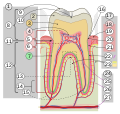 Cross sections of teeth showing the apical foramen


