University of Pavia: Difference between revisions
CSV import |
CSV import |
||
| Line 1: | Line 1: | ||
{{short description|Public university in Pavia, Italy}} | |||
{{Use dmy dates|date=October 2023}} | |||
The '''University of Pavia''' ( | The '''University of Pavia''' (degli Studi di Pavia}}) is a public university located in [[Pavia]], [[Lombardy]], [[Italy]]. Founded in 1361, it is one of the oldest universities in the world. The university offers a wide range of undergraduate, graduate, and doctoral programs across various fields of study. | ||
==History== | ==History== | ||
The | The University of Pavia was established in 1361 by a charter granted by [[Holy Roman Emperor]] [[Charles IV]]. Initially, it was a school of law, but it soon expanded to include other disciplines. The university has a rich history, having been a center of learning during the [[Renaissance]] and a hub for scientific research in the 19th century. | ||
==Campus== | ==Campus== | ||
The | The university's main campus is located in the historic city of Pavia, with several buildings of architectural and historical significance. Notable structures include the [[Aula Scarpa]], the [[Aula Volta]], and the [[Biblioteca Universitaria]]. The university also has a botanical garden, the [[Orto Botanico di Pavia]], which is used for research and educational purposes. | ||
== | ==Academics== | ||
The University of Pavia offers a wide range of | The University of Pavia offers a wide range of academic programs through its 18 departments. It is particularly renowned for its programs in [[law]], [[medicine]], [[engineering]], and the [[humanities]]. The university is also home to several research centers and institutes, including the [[Centro Manoscritti]] and the [[Museo Golgi]]. | ||
== | ==Colleges== | ||
Pavia is unique in Italy for its system of university colleges, which provide accommodation and additional educational opportunities for students. Notable colleges include the [[Collegio Borromeo]], [[Collegio Ghislieri]], and [[Collegio Castiglioni]]. These colleges have a long tradition of fostering academic excellence and community life. | |||
==Notable Alumni== | ==Notable Alumni== | ||
The University of Pavia has produced | The University of Pavia has produced many distinguished alumni, including [[Alessandro Volta]], the inventor of the electric battery, and [[Camillo Golgi]], a Nobel laureate in medicine. More recently, [[Samantha Cristoforetti]], an astronaut with the [[European Space Agency]], received an honorary degree from the university. | ||
== | ==Related pages== | ||
* [[List of universities in Italy]] | |||
* [[Pavia]] | |||
* [[Alessandro Volta]] | |||
== | ==Gallery== | ||
<gallery> | |||
File:Logo_UNIPV.svg|Logo of the University of Pavia | |||
File:Baldo_degli_ubaldi11.jpg|Historic building in Pavia | |||
File:Biblioteca_universitaria_(1).jpg|University Library | |||
File:Aula_volta_pavia.jpg|Aula Volta | |||
File:Pila_di_volta.jpg|Volta's Pile | |||
File:Kosmos_(Pavia)_rinoceronte.jpg|Kosmos Museum exhibit | |||
File:Museo_golgi.jpg|Golgi Museum | |||
File:OrtoBotanicoPavia-GiuseppeGregorelli-005.JPG|Botanical Garden | |||
File:Collegio_borromeo12.jpg|Collegio Borromeo | |||
File:Collegio_Ghislieri_(Pavia).JPG|Collegio Ghislieri | |||
File:Collegio_castiglioni_facciata.jpg|Collegio Castiglioni | |||
File:Laurea_honoris_causa_a_Samantha_Cristoforetti_(26532078029).jpg|Samantha Cristoforetti receiving honorary degree | |||
</gallery> | |||
[[Category:University of Pavia]] | |||
[[Category:Universities in Italy]] | [[Category:Universities in Italy]] | ||
[[Category: | [[Category:Educational institutions established in the 14th century]] | ||
Latest revision as of 01:22, 10 February 2025
Public university in Pavia, Italy
The University of Pavia (
| Italian language and its dialects | ||||||||||
|---|---|---|---|---|---|---|---|---|---|---|
This Italian language-related article is a stub. You can help WikiMD by expanding it.
|
) is a public university located in Pavia, Lombardy, Italy. Founded in 1361, it is one of the oldest universities in the world. The university offers a wide range of undergraduate, graduate, and doctoral programs across various fields of study.
History[edit]
The University of Pavia was established in 1361 by a charter granted by Holy Roman Emperor Charles IV. Initially, it was a school of law, but it soon expanded to include other disciplines. The university has a rich history, having been a center of learning during the Renaissance and a hub for scientific research in the 19th century.
Campus[edit]
The university's main campus is located in the historic city of Pavia, with several buildings of architectural and historical significance. Notable structures include the Aula Scarpa, the Aula Volta, and the Biblioteca Universitaria. The university also has a botanical garden, the Orto Botanico di Pavia, which is used for research and educational purposes.
Academics[edit]
The University of Pavia offers a wide range of academic programs through its 18 departments. It is particularly renowned for its programs in law, medicine, engineering, and the humanities. The university is also home to several research centers and institutes, including the Centro Manoscritti and the Museo Golgi.
Colleges[edit]
Pavia is unique in Italy for its system of university colleges, which provide accommodation and additional educational opportunities for students. Notable colleges include the Collegio Borromeo, Collegio Ghislieri, and Collegio Castiglioni. These colleges have a long tradition of fostering academic excellence and community life.
Notable Alumni[edit]
The University of Pavia has produced many distinguished alumni, including Alessandro Volta, the inventor of the electric battery, and Camillo Golgi, a Nobel laureate in medicine. More recently, Samantha Cristoforetti, an astronaut with the European Space Agency, received an honorary degree from the university.
Related pages[edit]
Gallery[edit]
-
 Logo of the University of Pavia
 -
 Historic building in Pavia
 -
 University Library
 -
 Aula Volta
 -
 Volta's Pile
 -
 Kosmos Museum exhibit
 -
 Golgi Museum
 -
 Botanical Garden
 -
 Collegio Borromeo
 -
 Collegio Ghislieri
 -
 Collegio Castiglioni
 -
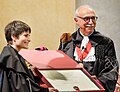 Samantha Cristoforetti receiving honorary degree


.jpg)


_rinoceronte.jpg)


.JPG)

.jpg)
