Triboelectric effect: Difference between revisions
CSV import |
CSV import |
||
| Line 1: | Line 1: | ||
{{Short description|Phenomenon where certain materials become electrically charged after coming into contact with a different material}} | |||
The '''triboelectric effect''' is a type of contact electrification in which certain materials become electrically charged after they are separated from a different material with which they were in contact. This phenomenon is commonly experienced in everyday life, such as when a person walks across a carpet and then touches a metal doorknob, resulting in a static shock. | |||
The triboelectric effect is a | |||
==Mechanism== | ==Mechanism== | ||
The triboelectric effect occurs when two materials are brought into contact and then separated. During contact, electrons may transfer from one material to the other, depending on their relative positions in the [[triboelectric series]]. The material that loses electrons becomes positively charged, while the material that gains electrons becomes negatively charged. | |||
The amount of charge transferred depends on several factors, including the nature of the materials, the surface roughness, and the environmental conditions such as humidity. The presence of [[asperities]] or microscopic surface roughness can enhance the effect by increasing the contact area. | |||
==Triboelectric Series== | |||
The [[triboelectric series]] is a list that ranks materials according to their tendency to gain or lose electrons. Materials at the top of the series, such as glass, tend to lose electrons and become positively charged, while materials at the bottom, such as rubber, tend to gain electrons and become negatively charged. | |||
==Applications== | ==Applications== | ||
The triboelectric effect has | The triboelectric effect has several practical applications. It is used in [[triboelectric nanogenerators]] (TENGs) to convert mechanical energy into electrical energy. These devices can harvest energy from various sources, such as human motion or environmental vibrations. | ||
The effect is also utilized in [[electrostatic precipitators]] to remove particles from exhaust gases in industrial processes. Additionally, it plays a role in the operation of [[xerography]], a dry photocopying technique. | |||
== | ==Hazards== | ||
The triboelectric effect can pose hazards in certain situations. For example, static electricity generated by the effect can ignite flammable gases or dust, leading to explosions. In the electronics industry, static discharge can damage sensitive components, necessitating the use of [[antistatic]] measures. | |||
== | ==Related pages== | ||
* [[Static electricity]] | |||
* [[Electrostatic discharge]] | * [[Electrostatic discharge]] | ||
* [[ | * [[Electrostatics]] | ||
* [[ | * [[Contact electrification]] | ||
==References== | ==References== | ||
< | * Jones, T. B. (2001). ''Electromechanics of Particles''. Cambridge University Press. | ||
* Harper, W. R. (1967). ''Contact and Frictional Electrification''. Oxford University Press. | |||
==Gallery== | |||
<gallery> | |||
File:Cat demonstrating static cling with styrofoam peanuts.jpg|A cat demonstrating static cling with styrofoam peanuts. | |||
File:Hauksbee Generator.JPG|A Hauksbee generator, an early device for generating static electricity. | |||
File:Asperities charged.svg|Diagram showing asperities charged by the triboelectric effect. | |||
File:Triboelectric-series EN.svg|The triboelectric series, showing materials ranked by their tendency to gain or lose electrons. | |||
File:Cyclic triboelectric series example.png|Example of a cyclic triboelectric series. | |||
File:Work function mismatch gold aluminum.svg|Diagram showing work function mismatch between gold and aluminum. | |||
File:Capacitor schematic with dielectric.svg|Schematic of a capacitor with a dielectric material. | |||
File:Tribocharge generated from a sliding drop.tif|Tribocharge generated from a sliding drop. | |||
File:Danger static electricity.png|Warning sign for danger of static electricity. | |||
File:Winglet Airbus A319-132.jpg|Winglet of an Airbus A319-132, where static electricity can accumulate. | |||
File:Antistatremmar.jpg|Antistatic wrist strap used to prevent electrostatic discharge. | |||
</gallery> | |||
[[Category:Electrostatics]] | [[Category:Electrostatics]] | ||
Revision as of 00:40, 10 February 2025
Phenomenon where certain materials become electrically charged after coming into contact with a different material
The triboelectric effect is a type of contact electrification in which certain materials become electrically charged after they are separated from a different material with which they were in contact. This phenomenon is commonly experienced in everyday life, such as when a person walks across a carpet and then touches a metal doorknob, resulting in a static shock.
Mechanism
The triboelectric effect occurs when two materials are brought into contact and then separated. During contact, electrons may transfer from one material to the other, depending on their relative positions in the triboelectric series. The material that loses electrons becomes positively charged, while the material that gains electrons becomes negatively charged.
The amount of charge transferred depends on several factors, including the nature of the materials, the surface roughness, and the environmental conditions such as humidity. The presence of asperities or microscopic surface roughness can enhance the effect by increasing the contact area.
Triboelectric Series
The triboelectric series is a list that ranks materials according to their tendency to gain or lose electrons. Materials at the top of the series, such as glass, tend to lose electrons and become positively charged, while materials at the bottom, such as rubber, tend to gain electrons and become negatively charged.
Applications
The triboelectric effect has several practical applications. It is used in triboelectric nanogenerators (TENGs) to convert mechanical energy into electrical energy. These devices can harvest energy from various sources, such as human motion or environmental vibrations.
The effect is also utilized in electrostatic precipitators to remove particles from exhaust gases in industrial processes. Additionally, it plays a role in the operation of xerography, a dry photocopying technique.
Hazards
The triboelectric effect can pose hazards in certain situations. For example, static electricity generated by the effect can ignite flammable gases or dust, leading to explosions. In the electronics industry, static discharge can damage sensitive components, necessitating the use of antistatic measures.
Related pages
References
- Jones, T. B. (2001). Electromechanics of Particles. Cambridge University Press.
- Harper, W. R. (1967). Contact and Frictional Electrification. Oxford University Press.
Gallery
-
 A cat demonstrating static cling with styrofoam peanuts.
 -
 A Hauksbee generator, an early device for generating static electricity.
 -
 Diagram showing asperities charged by the triboelectric effect.
 -
 The triboelectric series, showing materials ranked by their tendency to gain or lose electrons.
 -
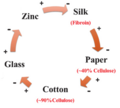 Example of a cyclic triboelectric series.
 -
 Diagram showing work function mismatch between gold and aluminum.
 -
 Schematic of a capacitor with a dielectric material.
 -
 Tribocharge generated from a sliding drop.
 -
 Warning sign for danger of static electricity.
 -
 Winglet of an Airbus A319-132, where static electricity can accumulate.
 -
Antistatic wrist strap used to prevent electrostatic discharge.


