Vark: Difference between revisions
CSV import |
CSV import |
||
| Line 1: | Line 1: | ||
{{short description|Indian sweet made from milk and sugar}} | |||
{{Use Indian English|date=October 2023}} | |||
{{Use dmy dates|date=October 2023}} | |||
'''Vark''' is a traditional [[Indian cuisine|Indian]] sweet known for its distinctive silver or gold leaf coating. It is commonly used to decorate a variety of [[sweets]] and [[desserts]] in [[India]]. | |||
==Description== | |||
Vark, also spelled as varak, is an ultra-thin layer of pure [[metal leaf|metal]], typically [[silver]] or [[gold]], that is used to garnish sweets. The leaf is so thin that it disintegrates in the mouth without altering the taste of the sweet it adorns. Vark is primarily used for its aesthetic appeal, giving sweets a luxurious and festive appearance. | |||
== Production == | ==Production== | ||
The production of vark involves hammering the metal into extremely thin sheets. Traditionally, this process was done manually, but modern techniques often use machines to achieve the desired thinness. The sheets are then cut into small pieces and applied to sweets using a special brush or by hand. | |||
Vark is | ==Uses== | ||
Vark is most commonly used in [[Indian sweets]] such as [[barfi]], [[gulab jamun]], and [[mawa]] sweets. It is especially popular during festivals like [[Diwali]], where sweets are exchanged as gifts. The use of vark is not limited to sweets; it is also used to decorate [[paan]] and other traditional Indian dishes. | |||
== | ==Health and Safety== | ||
The use of vark has been subject to scrutiny due to concerns about the purity of the metals used. In India, the [[Food Safety and Standards Authority of India]] (FSSAI) regulates the production and use of vark to ensure it is safe for consumption. Pure silver and gold are considered safe, but there have been instances of contamination with other metals, which can pose health risks. | |||
Vark | ==Cultural Significance== | ||
Vark holds cultural significance in Indian society, symbolizing wealth and prosperity. Its use in sweets during festivals and celebrations is a reflection of the importance of these occasions in Indian culture. | |||
== | ==Gallery== | ||
<gallery> | |||
File:Maawa_mithai.JPG|Mawa sweets decorated with vark | |||
File:Diwali_sweets_India_2009.jpg|Diwali sweets with vark | |||
File:Silver_Coated_Spices_By_Shree_Aditya_Silver_Leaves.jpg|Silver-coated spices | |||
</gallery> | |||
==Related pages== | |||
* [[Indian cuisine]] | |||
* [[Barfi]] | |||
* [[Gulab jamun]] | |||
* [[Diwali]] | |||
== | ==References== | ||
{{reflist}} | |||
[[Category:Indian cuisine]] | [[Category:Indian cuisine]] | ||
[[Category: | [[Category:Indian desserts]] | ||
[[Category: | [[Category:Food decoration]] | ||
Revision as of 23:59, 9 February 2025
Indian sweet made from milk and sugar
Vark is a traditional Indian sweet known for its distinctive silver or gold leaf coating. It is commonly used to decorate a variety of sweets and desserts in India.
Description
Vark, also spelled as varak, is an ultra-thin layer of pure metal, typically silver or gold, that is used to garnish sweets. The leaf is so thin that it disintegrates in the mouth without altering the taste of the sweet it adorns. Vark is primarily used for its aesthetic appeal, giving sweets a luxurious and festive appearance.
Production
The production of vark involves hammering the metal into extremely thin sheets. Traditionally, this process was done manually, but modern techniques often use machines to achieve the desired thinness. The sheets are then cut into small pieces and applied to sweets using a special brush or by hand.
Uses
Vark is most commonly used in Indian sweets such as barfi, gulab jamun, and mawa sweets. It is especially popular during festivals like Diwali, where sweets are exchanged as gifts. The use of vark is not limited to sweets; it is also used to decorate paan and other traditional Indian dishes.
Health and Safety
The use of vark has been subject to scrutiny due to concerns about the purity of the metals used. In India, the Food Safety and Standards Authority of India (FSSAI) regulates the production and use of vark to ensure it is safe for consumption. Pure silver and gold are considered safe, but there have been instances of contamination with other metals, which can pose health risks.
Cultural Significance
Vark holds cultural significance in Indian society, symbolizing wealth and prosperity. Its use in sweets during festivals and celebrations is a reflection of the importance of these occasions in Indian culture.
Gallery
-
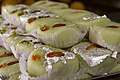 Mawa sweets decorated with vark
 -
 Diwali sweets with vark
 -
 Silver-coated spices


Related pages
References
<references group="" responsive="1"></references>
