Uropygial gland: Difference between revisions
CSV import |
CSV import |
||
| Line 1: | Line 1: | ||
{{Short description|A gland found in birds}} | |||
{{Taxobox}} | |||
The '''uropygial gland''', also known as the '''preen gland''', is a specialized gland found in most [[bird]]s. It is located at the base of the tail and secretes an oily substance that birds use to maintain the health and integrity of their [[feathers]]. | |||
The uropygial gland is a bilobed structure that | ==Structure== | ||
The uropygial gland is typically a bilobed structure situated dorsally at the base of the tail. It is composed of secretory lobes that produce the oil, which is then excreted through a small papilla. The size and shape of the gland can vary significantly among different bird species. | |||
The | ==Function== | ||
The primary function of the uropygial gland is to produce an oily secretion that birds apply to their feathers during preening. This oil helps to condition and waterproof the feathers, which is essential for flight and insulation. The oil may also have antibacterial and antifungal properties, helping to protect the feathers from microbial degradation. | |||
== | ==Behavior== | ||
Birds use their beaks to collect the oil from the gland and distribute it across their feathers. This behavior is known as [[preening]]. Some birds, such as the [[Blue Jay]], have been observed using the oil in a behavior called "anting," where they apply the oil to ants before rubbing them on their feathers. | |||
==Variations among species== | |||
Not all birds have a uropygial gland. For example, some [[pigeon]]s and [[parrot]]s lack this gland. In species that do have it, the gland's size and activity can vary with factors such as [[season]] and [[hormonal]] changes. | |||
==Images== | |||
<gallery> | |||
File:Buerzeldruese.jpg|A close-up of the uropygial gland. | |||
File:Blue_Jay_anting,_showing_uropygial_gland.jpg|A Blue Jay displaying its uropygial gland while anting. | |||
File:Glande_uropygienne.jpg|The uropygial gland of a bird. | |||
File:White-winged_Crossbill_Uropygial.JPG|The uropygial gland of a White-winged Crossbill. | |||
File:Common_Hoopoe_(Upapa_epops)_at_Puri_Im_IMG_9204.jpg|A Common Hoopoe showing its uropygial gland. | |||
</gallery> | |||
== | ==Related pages== | ||
* [[Feather]] | |||
* [[Preening]] | |||
* [[Bird anatomy]] | * [[Bird anatomy]] | ||
==References== | |||
* Jacob, J., Ziswiler, V. (1982). "The uropygial gland." In: Avian Biology, Vol. 6, pp. 199-324. | |||
* Elder, W. H. (1954). "The oil gland of birds." Wilson Bulletin, 66(1), 6-31. | |||
[[Category:Bird anatomy]] | [[Category:Bird anatomy]] | ||
[[Category: | [[Category:Bird physiology]] | ||
Revision as of 23:52, 9 February 2025
The uropygial gland, also known as the preen gland, is a specialized gland found in most birds. It is located at the base of the tail and secretes an oily substance that birds use to maintain the health and integrity of their feathers.
Structure
The uropygial gland is typically a bilobed structure situated dorsally at the base of the tail. It is composed of secretory lobes that produce the oil, which is then excreted through a small papilla. The size and shape of the gland can vary significantly among different bird species.
Function
The primary function of the uropygial gland is to produce an oily secretion that birds apply to their feathers during preening. This oil helps to condition and waterproof the feathers, which is essential for flight and insulation. The oil may also have antibacterial and antifungal properties, helping to protect the feathers from microbial degradation.
Behavior
Birds use their beaks to collect the oil from the gland and distribute it across their feathers. This behavior is known as preening. Some birds, such as the Blue Jay, have been observed using the oil in a behavior called "anting," where they apply the oil to ants before rubbing them on their feathers.
Variations among species
Not all birds have a uropygial gland. For example, some pigeons and parrots lack this gland. In species that do have it, the gland's size and activity can vary with factors such as season and hormonal changes.
Images
-
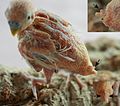 A close-up of the uropygial gland.
 -
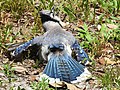 A Blue Jay displaying its uropygial gland while anting.
 -
 The uropygial gland of a bird.
 -
 The uropygial gland of a White-winged Crossbill.
 -
 A Common Hoopoe showing its uropygial gland.


_at_Puri_Im_IMG_9204.jpg)
Related pages
References
- Jacob, J., Ziswiler, V. (1982). "The uropygial gland." In: Avian Biology, Vol. 6, pp. 199-324.
- Elder, W. H. (1954). "The oil gland of birds." Wilson Bulletin, 66(1), 6-31.
