Trichilemmoma: Difference between revisions
CSV import |
CSV import Tags: mobile edit mobile web edit |
||
| Line 1: | Line 1: | ||
{{Short description|A benign skin tumor originating from the outer root sheath of a hair follicle}} | |||
{{Use dmy dates|date=October 2023}} | |||
'''Trichilemmoma''' is a benign [[skin tumor]] that arises from the outer root sheath of a [[hair follicle]]. It is considered a type of [[adnexal tumor]], which are tumors related to skin appendages. Trichilemmomas are often associated with [[Cowden syndrome]], a genetic disorder that predisposes individuals to multiple noncancerous, tumor-like growths. | |||
== | ==Presentation== | ||
Trichilemmomas typically present as small, flesh-colored or slightly pigmented papules. They are most commonly found on the [[face]], particularly around the [[nose]] and [[ears]]. These lesions are usually asymptomatic and are often discovered incidentally during a routine skin examination. | |||
== | ==Histopathology== | ||
Under the microscope, trichilemmomas exhibit characteristic features. They are composed of lobules of clear cells that resemble the outer root sheath of a hair follicle. The cells have a glycogen-rich cytoplasm, which gives them a clear appearance. The tumor is well-circumscribed and often shows a connection to the overlying epidermis. | |||
== | ==Diagnosis== | ||
The diagnosis of trichilemmoma is primarily based on histological examination. A skin biopsy is performed, and the tissue is examined under a microscope to confirm the presence of the characteristic clear cells and lobular architecture. | |||
== | ==Treatment== | ||
Trichilemmomas are benign and do not require treatment unless they are causing cosmetic concerns or discomfort. In such cases, they can be removed surgically. It is important to monitor individuals with multiple trichilemmomas for signs of Cowden syndrome, as this condition requires further medical evaluation and management. | |||
==Cowden Syndrome== | |||
Trichilemmomas are one of the hallmark features of [[Cowden syndrome]], an autosomal dominant genetic disorder caused by mutations in the [[PTEN]] gene. Individuals with Cowden syndrome have an increased risk of developing various types of [[cancer]], including [[breast cancer]], [[thyroid cancer]], and [[endometrial cancer]]. | |||
==Related pages== | |||
* [[Cowden syndrome]] | * [[Cowden syndrome]] | ||
* [[ | * [[Adnexal tumor]] | ||
* [[ | * [[PTEN gene]] | ||
==References== | |||
* Starink, T. M. (1985). "Trichilemmoma and Cowden's disease." ''Journal of the American Academy of Dermatology'', 13(3), 423-431. | |||
* Brownstein, M. H., & Shapiro, L. (1973). "Trichilemmoma: A clinicopathologic study." ''Cancer'', 32(4), 915-921. | |||
==Gallery== | |||
<gallery> | |||
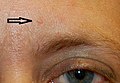
File:SkinTumors-P6190341.JPG|Trichilemmoma on the skin | |||
File:Trichilemmoma_-_Nci-vol-9808-72.jpg|Histological image of trichilemmoma | |||
</gallery> | |||
[[Category:Benign neoplasms]] | [[Category:Benign neoplasms]] | ||
[[Category:Dermatology]] | [[Category:Dermatology]] | ||
Revision as of 20:58, 9 February 2025
A benign skin tumor originating from the outer root sheath of a hair follicle
Trichilemmoma is a benign skin tumor that arises from the outer root sheath of a hair follicle. It is considered a type of adnexal tumor, which are tumors related to skin appendages. Trichilemmomas are often associated with Cowden syndrome, a genetic disorder that predisposes individuals to multiple noncancerous, tumor-like growths.
Presentation
Trichilemmomas typically present as small, flesh-colored or slightly pigmented papules. They are most commonly found on the face, particularly around the nose and ears. These lesions are usually asymptomatic and are often discovered incidentally during a routine skin examination.
Histopathology
Under the microscope, trichilemmomas exhibit characteristic features. They are composed of lobules of clear cells that resemble the outer root sheath of a hair follicle. The cells have a glycogen-rich cytoplasm, which gives them a clear appearance. The tumor is well-circumscribed and often shows a connection to the overlying epidermis.
Diagnosis
The diagnosis of trichilemmoma is primarily based on histological examination. A skin biopsy is performed, and the tissue is examined under a microscope to confirm the presence of the characteristic clear cells and lobular architecture.
Treatment
Trichilemmomas are benign and do not require treatment unless they are causing cosmetic concerns or discomfort. In such cases, they can be removed surgically. It is important to monitor individuals with multiple trichilemmomas for signs of Cowden syndrome, as this condition requires further medical evaluation and management.
Cowden Syndrome
Trichilemmomas are one of the hallmark features of Cowden syndrome, an autosomal dominant genetic disorder caused by mutations in the PTEN gene. Individuals with Cowden syndrome have an increased risk of developing various types of cancer, including breast cancer, thyroid cancer, and endometrial cancer.
Related pages
References
- Starink, T. M. (1985). "Trichilemmoma and Cowden's disease." Journal of the American Academy of Dermatology, 13(3), 423-431.
- Brownstein, M. H., & Shapiro, L. (1973). "Trichilemmoma: A clinicopathologic study." Cancer, 32(4), 915-921.
Gallery
-
 Trichilemmoma on the skin
 -
 Histological image of trichilemmoma


