Kelp: Difference between revisions
CSV import Tags: mobile edit mobile web edit |
CSV import |
||
| Line 28: | Line 28: | ||
[[Category:Marine biology]] | [[Category:Marine biology]] | ||
[[Category:Ecology]] | [[Category:Ecology]] | ||
== Kelp == | |||
<gallery> | |||
File:Kelp_In_Freycinet_Tasmania.jpg|Kelp In Freycinet Tasmania | |||
File:Chowiet_Island_beach_kelp.jpg|Chowiet Island beach kelp | |||
File:Five-ribbed_kelp_(Costaria_costata).jpg|Five-ribbed kelp (Costaria costata) | |||
File:KelpforestI2500ppx.JPG|Kelp forest | |||
File:Anemone_and_seastar_in_kelp_forest.jpg|Anemone and seastar in kelp forest | |||
File:Morskaja-kapusta.jpg|Morskaja kapusta | |||
File:Scuba_diver_in_kelp_forest.jpg|Scuba diver in kelp forest | |||
File:Giant_kelp_(Macrocystis_pyrifera)_01.jpg|Giant kelp (Macrocystis pyrifera) | |||
File:Blue_Rockfish_in_kelp_forest.jpg|Blue Rockfish in kelp forest | |||
File:Kelp_forest-blue.jpg|Kelp forest blue | |||
File:CLOSE_UP_OF_ECKLONIA_MAXIMA_LEAF.jpg|Close up of Ecklonia maxima leaf | |||
File:Kelpwik.jpg|Kelp | |||
</gallery> | |||
Latest revision as of 21:17, 23 February 2025
An overview of kelp, its biology, uses, and ecological importance
Overview[edit]
Kelp is a type of large brown algae that belongs to the order Laminariales. It is found in underwater forests in shallow oceans and is known for its rapid growth and high productivity. Kelp forests are among the most dynamic and productive ecosystems on Earth.
Biology[edit]
Kelp is a type of macroalgae that can grow to enormous sizes, with some species reaching lengths of over 45 meters (150 feet). The structure of kelp includes the holdfast, which anchors it to the ocean floor, the stipe, which is similar to a stem, and the fronds, which are leaf-like structures that perform photosynthesis. Kelp also has bladders filled with gas that help it float towards the surface to access sunlight.
Reproduction[edit]
Kelp reproduces through a complex life cycle that includes both sexual and asexual phases. The sporophyte is the large, visible form of the kelp, which produces spores that develop into microscopic gametophytes. These gametophytes produce gametes that fuse to form new sporophytes.
Ecological Importance[edit]
Kelp forests provide habitat and food for a diverse array of marine life, including fish, invertebrates, and marine mammals. They play a crucial role in coastal ecosystems by providing shelter and nutrients. Kelp forests also help to protect coastlines from storm surges and erosion.
Uses[edit]
Kelp has been used by humans for centuries. It is harvested for its alginates, which are used as thickening agents in food and cosmetics. Kelp is also consumed directly in some cultures, particularly in East Asia, where it is used in dishes such as kombu. Additionally, kelp is used as a fertilizer and as a source of biofuel.
Conservation[edit]
Kelp forests are threatened by various factors, including climate change, pollution, and overfishing. Conservation efforts are focused on protecting these vital ecosystems through marine protected areas and sustainable harvesting practices.
Related pages[edit]
Kelp[edit]
-
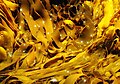 Kelp In Freycinet Tasmania
 -
Chowiet Island beach kelp
-
Five-ribbed kelp (Costaria costata)
-
Kelp forest
-
Anemone and seastar in kelp forest
-
Morskaja kapusta
-
Scuba diver in kelp forest
-
Giant kelp (Macrocystis pyrifera)
-
Blue Rockfish in kelp forest
-
Kelp forest blue
-
Close up of Ecklonia maxima leaf
-
Kelp


.jpg)


_01.jpg)


