Antigen presentation: Difference between revisions
CSV import |
CSV import |
||
| Line 4: | Line 4: | ||
File:MHC2.svg|MHC Class II | File:MHC2.svg|MHC Class II | ||
</gallery> | </gallery> | ||
== Antigen Presentation == | |||
'''Antigen presentation''' is a crucial immunological process that involves the display of [[antigen]]s on the surface of certain cells, known as [[antigen-presenting cells]] (APCs), to be recognized by [[T cells]]. This process is essential for the activation of the adaptive immune response. | |||
=== Overview === | |||
Antigen presentation is a key step in the immune response, bridging the innate and adaptive immune systems. It involves the processing of antigens and their presentation on the cell surface in association with [[major histocompatibility complex]] (MHC) molecules. There are two main pathways of antigen presentation: the endogenous pathway and the exogenous pathway. | |||
=== Endogenous Pathway === | |||
The endogenous pathway is responsible for presenting intracellular antigens, typically derived from [[virus|viral]] infections or [[tumor]] cells. Proteins within the cell are degraded into peptides by the [[proteasome]]. These peptides are then transported into the [[endoplasmic reticulum]] by the transporter associated with antigen processing (TAP). Within the endoplasmic reticulum, peptides bind to MHC class I molecules. The peptide-MHC class I complexes are then transported to the cell surface, where they can be recognized by [[CD8+ T cells]]. | |||
=== Exogenous Pathway === | |||
The exogenous pathway involves the presentation of extracellular antigens that have been internalized by the cell. These antigens are taken up by [[phagocytosis]] or [[endocytosis]] and are processed in [[endosome]]s or [[lysosome]]s. The resulting peptides are loaded onto MHC class II molecules within these vesicles. The peptide-MHC class II complexes are then transported to the cell surface for recognition by [[CD4+ T cells]]. | |||
=== Antigen-Presenting Cells === | |||
Antigen-presenting cells are specialized cells that are capable of processing and presenting antigens to T cells. The main types of APCs include [[dendritic cell]]s, [[macrophage]]s, and [[B cell]]s. Dendritic cells are considered the most potent APCs and are primarily responsible for initiating T cell responses. | |||
=== Role in Immune Response === | |||
Antigen presentation is critical for the activation of T cells, which are essential for the adaptive immune response. CD8+ T cells, also known as [[cytotoxic T lymphocyte]]s, are activated by antigens presented on MHC class I molecules and are responsible for killing infected or cancerous cells. CD4+ T cells, or [[helper T cell]]s, are activated by antigens presented on MHC class II molecules and help orchestrate the immune response by activating other immune cells, including B cells and macrophages. | |||
== Related Pages == | |||
* [[Major histocompatibility complex]] | |||
* [[T cell receptor]] | |||
* [[Adaptive immune system]] | |||
* [[Dendritic cell]] | |||
* [[Macrophage]] | |||
* [[B cell]] | |||
{{Immunology}} | |||
[[Category:Immunology]] | |||
Latest revision as of 00:41, 19 February 2025
-
 Antigen presentation
 -
 MHC Class I processing
 -
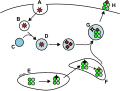 MHC Class II


Antigen Presentation[edit]
Antigen presentation is a crucial immunological process that involves the display of antigens on the surface of certain cells, known as antigen-presenting cells (APCs), to be recognized by T cells. This process is essential for the activation of the adaptive immune response.
Overview[edit]
Antigen presentation is a key step in the immune response, bridging the innate and adaptive immune systems. It involves the processing of antigens and their presentation on the cell surface in association with major histocompatibility complex (MHC) molecules. There are two main pathways of antigen presentation: the endogenous pathway and the exogenous pathway.
Endogenous Pathway[edit]
The endogenous pathway is responsible for presenting intracellular antigens, typically derived from viral infections or tumor cells. Proteins within the cell are degraded into peptides by the proteasome. These peptides are then transported into the endoplasmic reticulum by the transporter associated with antigen processing (TAP). Within the endoplasmic reticulum, peptides bind to MHC class I molecules. The peptide-MHC class I complexes are then transported to the cell surface, where they can be recognized by CD8+ T cells.
Exogenous Pathway[edit]
The exogenous pathway involves the presentation of extracellular antigens that have been internalized by the cell. These antigens are taken up by phagocytosis or endocytosis and are processed in endosomes or lysosomes. The resulting peptides are loaded onto MHC class II molecules within these vesicles. The peptide-MHC class II complexes are then transported to the cell surface for recognition by CD4+ T cells.
Antigen-Presenting Cells[edit]
Antigen-presenting cells are specialized cells that are capable of processing and presenting antigens to T cells. The main types of APCs include dendritic cells, macrophages, and B cells. Dendritic cells are considered the most potent APCs and are primarily responsible for initiating T cell responses.
Role in Immune Response[edit]
Antigen presentation is critical for the activation of T cells, which are essential for the adaptive immune response. CD8+ T cells, also known as cytotoxic T lymphocytes, are activated by antigens presented on MHC class I molecules and are responsible for killing infected or cancerous cells. CD4+ T cells, or helper T cells, are activated by antigens presented on MHC class II molecules and help orchestrate the immune response by activating other immune cells, including B cells and macrophages.
Related Pages[edit]
- Major histocompatibility complex
- T cell receptor
- Adaptive immune system
- Dendritic cell
- Macrophage
- B cell
| Immunology | ||||||||||
|---|---|---|---|---|---|---|---|---|---|---|
This immunology-related article is a stub.
|
