Bombay Stock Exchange: Difference between revisions
CSV import |
CSV import |
||
| Line 33: | Line 33: | ||
<gallery> | <gallery> | ||
File:Bombay_Stock_Exchange_logo.svg|Logo of the Bombay Stock Exchange | File:Bombay_Stock_Exchange_logo.svg|Logo of the Bombay Stock Exchange | ||
</gallery> | |||
<gallery> | |||
File:BSE_logo.svg|BSE Logo | |||
File:BSE_building_at_Dalal_Street.JPG|BSE Building at Dalal Street | |||
File:Bombay_Stock_Exchange_logo.svg|Bombay Stock Exchange Logo | |||
File:S&P_BSE_500_(1999_to_2020).png|S&P BSE 500 (1999 to 2020) | |||
File:S&P_BSE_SENSEX_chart.svg|S&P BSE SENSEX Chart | |||
</gallery> | </gallery> | ||
Latest revision as of 04:55, 18 February 2025

Bombay Stock Exchange (BSE) is one of the oldest and most prominent stock exchanges in Asia, located in Mumbai, India. Established on July 9, 1875, by Cotton trader Premchand Roychand, it is the first stock exchange in Asia and operates under the regulatory framework of the Securities and Exchange Board of India (SEBI). The BSE has played a crucial role in the development of the Indian capital market and is instrumental in providing a platform for trading in equity, debt instruments, and derivatives.
History[edit]
The origins of the Bombay Stock Exchange can be traced back to the 1850s when a group of stockbrokers would gather under a banyan tree in front of Mumbai's Town Hall. The formal establishment of the BSE in 1875 marked the beginning of organized trading in Indian securities. The BSE moved to its present building, the Phiroze Jeejeebhoy Towers, in 1980.
Market Structure[edit]
The BSE provides a transparent and efficient platform for trading in a variety of securities. It operates the world-renowned Sensex - the benchmark index of the BSE, which reflects the performance of 30 financially sound companies listed on the exchange. The Sensex is widely tracked by investors in India and around the globe.
Trading System[edit]
The BSE transitioned from an open outcry system to an electronic trading system in 1995. This system, known as BOLT (BSE On-Line Trading), has significantly increased the exchange's trading capacity and efficiency, allowing it to handle millions of transactions daily.
Listings[edit]
As of now, the BSE lists thousands of companies, making it one of the world's leading exchanges in terms of listed companies. The exchange provides a market for trading in various asset classes, including equity, debt, and derivatives.
Regulation[edit]
The BSE operates under the regulatory oversight of the Securities and Exchange Board of India (SEBI), which ensures the protection of investor interests and the enforcement of market rules and regulations.
Global Presence[edit]
The BSE has established links with several international exchanges and has been active in developing the global financial market. It has partnerships and memoranda of understanding with exchanges across the world to facilitate cross-listing and to enhance the global reach of its listed companies.
Education and Training[edit]
The BSE also focuses on educating and training market participants. It offers a range of courses and certifications aimed at enhancing the knowledge and skills of investors, traders, and finance professionals.
Challenges and Opportunities[edit]
The BSE faces challenges such as competition from other exchanges, technological advancements, and regulatory changes. However, it continues to innovate and expand its services to meet the evolving needs of the market.
Conclusion[edit]
The Bombay Stock Exchange stands as a testament to the growth and resilience of the Indian financial market. Its rich history, combined with its commitment to innovation and regulation, ensures its pivotal role in the global financial ecosystem.

-
 Logo of the Bombay Stock Exchange

-
 BSE Logo
 -
 BSE Building at Dalal Street
 -
Bombay Stock Exchange Logo
-
 S&P BSE 500 (1999 to 2020)
 -
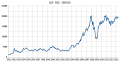 S&P BSE SENSEX Chart


.png)

