Acronychia oblongifolia: Difference between revisions
CSV import |
CSV import |
||
| Line 36: | Line 36: | ||
[[Category:Flora of Australia]] | [[Category:Flora of Australia]] | ||
[[Category:Trees of Australia]] | [[Category:Trees of Australia]] | ||
<gallery> | |||
File:Acronychia_oblongifolia_flowers.jpg|Acronychia oblongifolia flowers | |||
File:Acronychia_oblongifolia_fruit.jpg|Acronychia oblongifolia fruit | |||
</gallery> | |||
Latest revision as of 01:24, 18 February 2025
Acronychia oblongifolia[edit]
Acronychia oblongifolia, commonly known as white aspen, is a species of tree in the family Rutaceae. It is native to eastern Australia and is known for its distinctive flowers and fruit.
Description[edit]
Acronychia oblongifolia is a small to medium-sized tree that can grow up to 15 meters in height. The leaves are simple, opposite, and oblong to elliptical in shape, measuring 5–12 cm long and 2–5 cm wide. The leaves are glossy green on the upper surface and paler underneath.
The flowers are small, white, and arranged in clusters known as inflorescences. Each flower has four petals and is about 5–7 mm in diameter. The flowering period occurs from late summer to autumn.
The fruit is a fleshy, white to pale yellow drupe that is about 10–15 mm in diameter. The fruit is edible and has a citrus-like flavor.
Habitat and Distribution[edit]
Acronychia oblongifolia is found in rainforests and wet sclerophyll forests along the eastern coast of Australia, from New South Wales to Queensland. It thrives in well-drained soils and can often be found in subtropical and tropical regions.
Ecology[edit]
The fruit of Acronychia oblongifolia is consumed by various bird species, which aid in the dispersal of the seeds. The tree provides habitat and food for a range of fauna in its native ecosystem.
Uses[edit]
The fruit of Acronychia oblongifolia is edible and can be used in bush tucker. It has a tangy, citrus-like flavor and can be eaten raw or used in cooking.
Conservation[edit]
Acronychia oblongifolia is not currently considered threatened. However, like many native species, it can be affected by habitat loss and environmental changes.
Related pages[edit]
Gallery[edit]
-
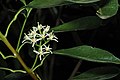 Acronychia oblongifolia flowers
 -
 Acronychia oblongifolia fruit


-
Acronychia oblongifolia flowers
-
Acronychia oblongifolia fruit
