Arcus senilis: Difference between revisions
From WikiMD's Wellness Encyclopedia
CSV import |
CSV import |
||
| Line 43: | Line 43: | ||
[[Category:Cardiac surgery]] | [[Category:Cardiac surgery]] | ||
[[Category:Heart valves]] | [[Category:Heart valves]] | ||
== Arcus senilis == | |||
<gallery> | |||
File:Four_representative_slides_of_corneal_arcus.jpg|Four representative slides of corneal arcus | |||
File:Corneal_arcus.jpg|Corneal arcus | |||
</gallery> | |||
Revision as of 01:32, 18 February 2025
Aortic Valve Repair
Aortic valve repair is a surgical procedure aimed at correcting defects or malfunctions of the aortic valve, which is one of the four main valves in the heart. This procedure is often performed to treat conditions such as aortic regurgitation or aortic stenosis. Unlike aortic valve replacement, which involves replacing the valve with a prosthetic one, aortic valve repair focuses on preserving the patient's native valve.
Indications
Aortic valve repair is indicated in patients with:
- Aortic regurgitation: A condition where the aortic valve does not close properly, allowing blood to flow backward into the left ventricle.
- Aortic stenosis: A narrowing of the aortic valve opening, which restricts blood flow from the left ventricle to the aorta.
- Congenital valve defects: Such as a bicuspid aortic valve, which may require repair to prevent future complications.
Surgical Techniques
Several techniques are employed in aortic valve repair, including:
- Leaflet repair: Involves reshaping or reinforcing the valve leaflets to ensure proper closure.
- Annuloplasty: A ring-like device is used to reshape or tighten the valve annulus, the ring of tissue supporting the valve.
- Commissurotomy: The surgical separation of fused valve leaflets to increase the valve opening.
- Patch augmentation: A patch is used to enlarge the valve leaflets or annulus, improving valve function.
Advantages
Aortic valve repair offers several advantages over valve replacement, including:
- Preservation of the patient's own valve, which may lead to better long-term outcomes.
- Reduced risk of thromboembolism compared to mechanical valve replacement.
- Avoidance of lifelong anticoagulation therapy, which is often required with mechanical valves.
Postoperative Care
After aortic valve repair, patients typically require:
- Monitoring in an intensive care unit (ICU) immediately following surgery.
- Regular follow-up appointments to assess valve function and overall heart health.
- Lifestyle modifications and medications to manage underlying heart conditions.
Related Pages
Gallery
-
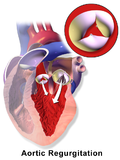 Diagram illustrating aortic regurgitation.
 -
 Preoperative view of the aortic valve.
 -
 Postoperative view of the aortic valve after repair.

Arcus senilis
-
 Four representative slides of corneal arcus
 -
Corneal arcus


