Leveillula taurica: Difference between revisions
CSV import |
CSV import |
||
| Line 23: | Line 23: | ||
{{food-stub}} | {{food-stub}} | ||
{{No image}} | {{No image}} | ||
== Leveillula taurica gallery == | |||
<gallery> | |||
File:5573619-PPT-powdery mildew (Leveillula taurica).jpg|Powdery mildew (Leveillula taurica) | |||
</gallery> | |||
Revision as of 05:37, 3 March 2025
Leveillula taurica is a species of fungal pathogen that is part of the Erysiphales order. It is known for causing powdery mildew in a wide range of crops and plants.
Taxonomy
The species was first described by Pierre Bulliard in 1791. It was later reclassified as Leveillula taurica by Augusto Chini in 1903. The species belongs to the Leveillula genus, which is part of the Erysiphaceae family.
Description
Leveillula taurica is a biotrophic fungus, meaning it derives its nutrients from living plant cells. It is characterized by its powdery white appearance on the surface of infected plants. The fungus produces conidia (asexual spores) that are wind-dispersed and can infect a wide range of host plants.
Hosts and symptoms
Leveillula taurica has a broad host range, including important crops such as tomato, pepper, onion, eggplant, and cotton. Symptoms of infection include chlorotic spots on the upper leaf surface, and a white, powdery growth on the lower leaf surface. Severe infections can lead to leaf curling, stunting, and yield loss.
Management
Management of Leveillula taurica involves a combination of cultural practices, biological control, and chemical control. Cultural practices include crop rotation and the use of resistant varieties. Biological control involves the use of biopesticides, while chemical control involves the use of fungicides.
See also


Leveillula taurica gallery
-
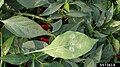 Powdery mildew (Leveillula taurica)
.jpg)
