Ethisterone: Difference between revisions
CSV import |
CSV import |
||
| Line 27: | Line 27: | ||
{{medicine-stub}} | {{medicine-stub}} | ||
{{No image}} | {{No image}} | ||
<gallery> | |||
File:Ethisterone.svg|Ethisterone | |||
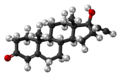
File:Ethisterone molecule ball.png|Ethisterone | |||
</gallery> | |||
Revision as of 01:02, 20 February 2025
Ethisterone is a synthetic steroid hormone belonging to the class of progestogens. It is an orally active progestogen which was previously used in the treatment of a variety of medical conditions but is now largely obsolete. Ethisterone is considered to be the first orally active progestogen, marking a significant milestone in the development of pharmacology and endocrinology.
History
Ethisterone was synthesized in 1938, making it one of the earliest synthetic progestogens. Its development was part of the broader effort to understand and synthesize hormones that could be used to regulate fertility and treat hormonal disorders. Ethisterone's introduction was a pivotal moment in the history of contraceptive technology and hormonal therapy.
Chemical Structure and Mechanism of Action
The chemical structure of Ethisterone closely resembles that of testosterone, but it has been modified to exhibit progestogenic activity. This modification allows Ethisterone to mimic the action of progesterone, a natural hormone essential for regulating menstruation and maintaining pregnancy. Ethisterone works by binding to and activating the progesterone receptor in the body, thereby exerting its effects.
Clinical Uses
Historically, Ethisterone was used to treat a range of conditions, including menstrual disorders, endometriosis, and to prevent miscarriages. It was also used in combination with estrogen in some of the first oral contraceptives. However, due to the development of more effective and safer progestogens, Ethisterone is no longer widely used in clinical practice.
Side Effects and Safety
Like other progestogens, Ethisterone can cause side effects, including nausea, weight gain, and mood changes. Its use has also been associated with an increased risk of certain types of cardiovascular disease, which has contributed to its decline in use. Patients are advised to consult with a healthcare provider to understand the risks and benefits of any hormone therapy.
Current Status
Today, Ethisterone is of historical interest more than clinical use. It represents an important step in the development of synthetic hormones for medical therapy. Researchers continue to study Ethisterone and other early synthetic hormones to better understand their mechanisms of action and to guide the development of new therapeutic agents.
See Also

-
 Ethisterone
 -
 Ethisterone


