Aminomethyltransferase: Difference between revisions
CSV import |
CSV import |
||
| Line 21: | Line 21: | ||
{{medicine-stub}} | {{medicine-stub}} | ||
{{No image}} | {{No image}} | ||
<gallery> | |||
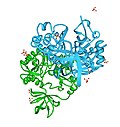
File:AMT-Aminomethiltransferase.jpg|AMT Aminomethyltransferase | |||
</gallery> | |||
Revision as of 05:33, 3 March 2025
Aminomethyltransferase (AMT) is an enzyme that plays a crucial role in the metabolism of amino acids, specifically in the catabolism of glycine. It is encoded by the AMT gene in humans. This enzyme is part of the glycine cleavage system (GCS), which is vital for the breakdown and utilization of glycine. Aminomethyltransferase facilitates the transfer of a methylamine group from glycine to tetrahydrofolate, producing ammonia and 5,10-methylenetetrahydrofolate, a critical step in the conversion of glycine into carbon dioxide and ammonia, and in the synthesis of purines, thymidylate, and methionine from folate.
Function
Aminomethyltransferase operates within the mitochondria, playing a pivotal role in cellular metabolism and energy production. By participating in the glycine cleavage system, AMT helps regulate glycine levels in tissues and is essential for the metabolic processing of glycine in liver and brain tissues, where glycine serves not only as a simple amino acid but also as a significant neurotransmitter.
Genetic and Clinical Significance
Mutations in the AMT gene are associated with a rare autosomal recessive disorder known as Glycine encephalopathy (also known as non-ketotic hyperglycinemia), characterized by elevated levels of glycine in the brain and other tissues, leading to severe neurological symptoms. Symptoms of glycine encephalopathy can include developmental delay, intellectual disability, seizures, and hypotonia. Diagnosis is often made through biochemical analysis and genetic testing, identifying mutations in the AMT gene among others related to the glycine cleavage system.
Structure
The structure of aminomethyltransferase, as determined through various biochemical and biophysical methods, reveals that it functions as part of a multi-enzyme complex. This complex facilitates the coordinated transfer of functional groups necessary for the efficient breakdown of glycine.
Pathology
Deficiencies in AMT activity due to genetic mutations result in the accumulation of glycine, which can be toxic to the brain, leading to the symptoms observed in glycine encephalopathy. Treatment options are limited and often focus on managing symptoms, although dietary restrictions and supplements can help regulate glycine levels in some cases.
Research Directions
Ongoing research aims to better understand the molecular mechanisms of AMT and the glycine cleavage system, their roles in health and disease, and to develop more effective treatments for disorders like glycine encephalopathy. Studies on the enzyme's structure and function also contribute to broader insights into amino acid metabolism and mitochondrial function.

-
 AMT Aminomethyltransferase

