University of Pisa: Difference between revisions
CSV import Tags: mobile edit mobile web edit |
CSV import |
||
| Line 44: | Line 44: | ||
[[Category:1343 establishments in Europe]] | [[Category:1343 establishments in Europe]] | ||
[[Category:Universities in Italy]] | [[Category:Universities in Italy]] | ||
<gallery> | |||
File:University_of_Pisa.svg|University of Pisa | |||
File:UniPI_Palazzo_Sapienza.jpg|Palazzo della Sapienza | |||
File:UniPi_Galileo_Galilei.jpeg|Statue of Galileo Galilei | |||
File:UniPi_battaglia_Curtatone_Montanara.jpg|Battle of Curtatone and Montanara | |||
File:UniPi_Calcolatrice_Elettronica_Pisana2.jpg|Calcolatrice Elettronica Pisana | |||
File:UniPi_robot_Centro_Piaggio.jpg|Robot at Centro Piaggio | |||
File:UniPi_Polo_Fibonacci.jpg|Polo Fibonacci | |||
</gallery> | |||
Latest revision as of 11:21, 18 February 2025
Public research university in Pisa, Italy
The University of Pisa (
| Italian language and its dialects | ||||||||||
|---|---|---|---|---|---|---|---|---|---|---|
This Italian language-related article is a stub. You can help WikiMD by expanding it.
|
) is a prestigious public research university located in Pisa, Italy. Founded in 1343, it is one of the oldest universities in the world and is renowned for its rich history and academic excellence.
History[edit]

The University of Pisa was officially established on September 3, 1343, by an edict of Pope Clement VI. However, its origins can be traced back to the 11th century when lectures on law were held in Pisa. The university has been a center of learning and research for centuries, contributing significantly to the cultural and scientific development of Italy and Europe.
During the Renaissance, the university flourished, attracting scholars from all over Europe. Notable figures such as Galileo Galilei were associated with the university, enhancing its reputation as a leading institution of higher learning.
Academic Structure[edit]
The University of Pisa is organized into 20 departments, offering a wide range of undergraduate, graduate, and doctoral programs. It is particularly renowned for its programs in engineering, computer science, and the natural sciences.
Notable Alumni and Faculty[edit]

The university has produced numerous notable alumni and faculty members, including:
- Galileo Galilei, the renowned physicist, mathematician, and astronomer.
- Enrico Fermi, a physicist known for his work on the development of the first nuclear reactor.
- Carlo Rubbia, a Nobel laureate in Physics.
Research and Innovation[edit]

The University of Pisa is a leader in research and innovation, with numerous research centers and laboratories. It is part of the European University Association and collaborates with various international institutions.
The university is known for its contributions to the fields of robotics, computer science, and engineering. The Centro Piaggio is a notable research center focusing on robotics and automation.
Campus and Facilities[edit]

The university's main campus is located in the heart of Pisa, with several buildings and facilities spread throughout the city. The historic Palazzo della Sapienza is one of the university's most iconic buildings.
Related Pages[edit]
References[edit]
- Hastings,
 The Universities of Europe in the Middle Ages,

 Oxford University Press,
 1895,
University of Pisa Official Website(link). {{{website}}}.
Accessed October 10, 2023.
-
University of Pisa
-
 Palazzo della Sapienza
 -
 Statue of Galileo Galilei
 -
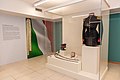 Battle of Curtatone and Montanara
 -
 Calcolatrice Elettronica Pisana
 -
 Robot at Centro Piaggio
 -
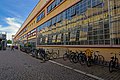 Polo Fibonacci


