Trigonocephaly: Difference between revisions
CSV import Tags: mobile edit mobile web edit |
CSV import |
||
| Line 43: | Line 43: | ||
[[Category:Craniofacial disorders]] | [[Category:Craniofacial disorders]] | ||
[[Category:Congenital disorders]] | [[Category:Congenital disorders]] | ||
<gallery> | |||
File:Trigonocephaly_(2).png|Trigonocephaly | |||
File:Trigonocephaly.png|Trigonocephaly | |||
File:Single_suture_synostosis.png|Single suture synostosis | |||
File:Wiki_trigonocephaly1.jpg|Trigonocephaly | |||
File:Wiki_trigonocephaly2.jpg|Trigonocephaly | |||
</gallery> | |||
Revision as of 04:38, 18 February 2025
Trigonocephaly is a type of craniosynostosis characterized by the premature fusion of the metopic suture, which is located at the forehead. This condition results in a triangular shape of the forehead and can lead to various developmental issues.
Signs and symptoms
Individuals with trigonocephaly often exhibit a noticeable ridge along the forehead, giving it a triangular appearance. Other symptoms may include:
- Hypotelorism (closely spaced eyes)
- Developmental delays
- Cognitive impairments
- Behavioral issues
Causes
The exact cause of trigonocephaly is not fully understood, but it is believed to involve a combination of genetic and environmental factors. Some cases are associated with genetic syndromes such as Crouzon syndrome and Apert syndrome.
Diagnosis
Diagnosis of trigonocephaly is typically made through physical examination and imaging studies such as CT scans or MRIs. These imaging techniques help to confirm the premature fusion of the metopic suture and assess the extent of the cranial deformity.
Treatment
The primary treatment for trigonocephaly is surgical intervention. Surgery is usually performed to correct the shape of the skull and allow for normal brain growth. The timing of surgery depends on the severity of the condition and the presence of any associated symptoms.
Prognosis
With early diagnosis and appropriate treatment, many children with trigonocephaly can lead normal lives. However, the prognosis can vary depending on the severity of the condition and the presence of any associated syndromes or developmental issues.
Related pages
Gallery
-
 Illustration of trigonocephaly
 -
 Diagram showing the triangular shape of the forehead
 -
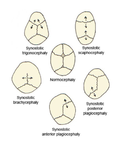 Image depicting single suture synostosis
 -
 Clinical image of a patient with trigonocephaly
 -
 Another clinical image showing trigonocephaly
.png)


References
-
Trigonocephaly
-
Trigonocephaly
-
Single suture synostosis
-
Trigonocephaly
-
Trigonocephaly
