Vangueria infausta: Difference between revisions
CSV import |
CSV import |
||
| Line 50: | Line 50: | ||
[[Category:Rubiaceae]] | [[Category:Rubiaceae]] | ||
[[Category:Flora of Southern Africa]] | [[Category:Flora of Southern Africa]] | ||
<gallery> | |||
File:Vangueria_infausta,_habitus,_Ncagaberg,_a.jpg|Vangueria infausta habitus at Ncagaberg | |||
File:Vangueria_infausta,_loof,_Walter_Sisulu_NBT.jpg|Vangueria infausta leaf at Walter Sisulu NBT | |||
File:Acalitus_mallyi-mytgalle_op_Vangueria_infausta,_Pretoria.jpg|Acalitus mallyi gall on Vangueria infausta, Pretoria | |||
File:Vangueria_infausta,_blomme,_Schanskop,_b.jpg|Vangueria infausta flowers at Schanskop | |||
File:Vangueria_infausta,_vrug,_Schanskop.jpg|Vangueria infausta fruit at Schanskop | |||
</gallery> | |||
Revision as of 11:29, 18 February 2025
Species of flowering plant
Vangueria infausta is a species of flowering plant in the family Rubiaceae. It is native to the southern regions of Africa, where it is commonly known as the wild medlar. This plant is notable for its edible fruit and its use in traditional medicine.
Description
Vangueria infausta is a small tree or shrub that typically grows to a height of 3 to 7 meters. The leaves are simple, opposite, and have a glossy green appearance. They are elliptic to obovate in shape, with a smooth margin. The flowers are small, white to greenish, and are borne in clusters. The fruit is a drupe, which turns from green to brown as it ripens, and is about 2 to 3 centimeters in diameter.

Distribution and habitat
Vangueria infausta is found in a variety of habitats, including woodlands, savannas, and grasslands. It is distributed across several countries in southern Africa, including South Africa, Botswana, Namibia, Zimbabwe, and Mozambique. The plant is well adapted to dry conditions and can often be found in areas with sandy or rocky soils.
Ecology
The fruit of Vangueria infausta is consumed by various animals, including birds and mammals, which aid in seed dispersal. The plant is also host to the mite Acalitus mallyi, which can cause galls on the leaves.

Uses
The fruit of Vangueria infausta is edible and is often eaten fresh or used to make beverages. It has a sweet and tangy flavor. In traditional medicine, various parts of the plant are used to treat ailments such as stomachaches and respiratory issues.
Gallery
-
 Flowers of Vangueria infausta
 -
 Ripe fruit of Vangueria infausta


Related pages
References
- Hyde, M.A., Wursten, B.T., Ballings, P. & Coates Palgrave, M. (2023). Vangueria infausta. Flora of Zimbabwe. Retrieved from https://www.zimbabweflora.co.zw/speciesdata/species.php?species_id=145690
- Van Wyk, B.-E., & Gericke, N. (2000). People's Plants: A Guide to Useful Plants of Southern Africa. Briza Publications.
-
 Vangueria infausta habitus at Ncagaberg
 -
 Vangueria infausta leaf at Walter Sisulu NBT
 -
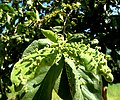 Acalitus mallyi gall on Vangueria infausta, Pretoria
 -
Vangueria infausta flowers at Schanskop
-
Vangueria infausta fruit at Schanskop

