Translocase: Difference between revisions
CSV import |
CSV import |
||
| Line 39: | Line 39: | ||
[[Category:Enzymes]] | [[Category:Enzymes]] | ||
[[Category:Membrane biology]] | [[Category:Membrane biology]] | ||
== Translocase == | |||
<gallery> | |||
File:Translocase_Mechanism.jpg|Translocase Mechanism | |||
File:PBB_Protein_TOMM20_image.jpg|PBB Protein TOMM20 | |||
File:Atp_synthase.PNG|ATP Synthase | |||
File:3b8e.png|Translocase | |||
</gallery> | |||
Latest revision as of 04:39, 18 February 2025
Enzyme that assists in moving another molecule, usually across a membrane
Translocase is a type of enzyme that facilitates the movement of molecules across biological membranes. These enzymes are crucial for various cellular processes, including the transport of proteins and other macromolecules into and out of organelles such as the mitochondria, chloroplasts, and the endoplasmic reticulum.
Function[edit]
Translocases play a vital role in the translocation of proteins across membranes. They are involved in the import and export of proteins, ensuring that proteins reach their correct cellular or organelle destination. This process is essential for maintaining cellular function and homeostasis.
Mechanism[edit]

Translocases operate by recognizing specific signal sequences on the proteins they transport. These signal sequences are typically short peptide chains that direct the protein to the appropriate translocase complex. Once recognized, the protein is threaded through a channel in the membrane, often with the assistance of additional proteins that provide the necessary energy and directionality for the process.
Types of Translocases[edit]
There are several types of translocases, each specific to the type of molecule they transport and the membrane they operate across. Some of the well-known translocases include:
- TOM complex (Translocase of the Outer Mitochondrial membrane): Responsible for the import of proteins into the mitochondria.
- TIM complex (Translocase of the Inner Mitochondrial membrane): Works in conjunction with the TOM complex to transport proteins into the mitochondrial matrix.
- Sec translocase: Involved in the translocation of proteins across the endoplasmic reticulum membrane.
Examples[edit]

One of the most studied translocases is the ATP synthase, which is involved in the synthesis of ATP in the mitochondria. ATP synthase is a complex enzyme that uses the proton gradient across the mitochondrial membrane to drive the synthesis of ATP from ADP and inorganic phosphate.

Related Proteins[edit]

Proteins such as chaperones and co-chaperones often assist translocases by maintaining the unfolded state of proteins during translocation or by providing the energy required for the process.
Related pages[edit]
References[edit]
- Alberts, B., Johnson, A., Lewis, J., Raff, M., Roberts, K., & Walter, P. (2002). Molecular Biology of the Cell. 4th edition. New York: Garland Science.
- Neupert, W., & Herrmann, J. M. (2007). Translocation of proteins into mitochondria. Annual Review of Biochemistry, 76, 723-749.
Translocase[edit]
-
 Translocase Mechanism
 -
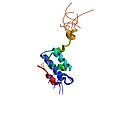 PBB Protein TOMM20
 -
 ATP Synthase
 -
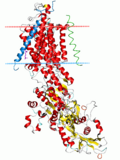 Translocase
